[ Coroner Lord Justice Scott Baker] said that he and the jury - plus one Diana fan who sat through all the proceedings with the words "Diana" and "Dodi" painted on his face - were the only ones to hear every word of evidence.
Mar 31, 2008
Just when you thought that your ability to be staggered by the absurdity of humanity had been destroyed by life in London something comes along and...
Back soon with some real content but just wanted to highlight this after six months of the inquest into the death of princess Diana:

Mar 8, 2008
The Little Venue that Could.

For eleven months of the year Edinburgh is a quiet place to live – for a capital city its almost suspiciously tranquil (as long as you avoid the half a mile of hen nights and gell-haired, liquored up Ben Shermanators that shuffle and stumble along the Cowgate into the Grassmaket, braying loudly and urinating at will, much as their bovine predecessors did before them). Even in the summer I remember only long days spent lying on the meadows and easy strolls along the bracingly beautiful crags, gazing out over a mess of roof tops, the castle floating off in the distance.
Come August however, things change. Quiet student union rooms accustomed only to well-organised fantasy wargaming and the occasional illicit sex act are suddenly bristling with chairs and wires and staff in gaudy matching t-shirts hastily taping everything to the floor. Churches that are almost conspicuously empty for the rest of the year suddenly find themselves plastered with sponsorship signs and MDF black boards. The royal mile wakes up one morning to find a series of grotesque plastic columns have been grafted to its cobbles, already being bandaged with brightly coloured posters by early-bird students filled with hope and a blind belief in the power of traditional advertising. Birds fly south, Scots fly north. The Festival has begun.
Every year the BBC and the national newspapers, in between shots of the same relentlessly irritating gold-covered man holding his bloody stupid bicycle, trip over each to point out the obvious misnomer in the title Edinburgh Fringe Festival – that 61 years and several thousand productions of John Godber’s Bouncers after it first strutted scruffily into the city there is very little that is fringe about this festival. It is, it grandly declares, the Largest Arts Festival in the world.
However, no one as yet however seems to have demonstrated that this is a good thing, and it feels to me at least that every year the emphasis falls more on the ‘festival’ and less on the ‘arts’.
Walking through the streets of the city during August, you can’t help but wonder if Edinburgh (the city, its festival) has lost its soul – or at least has misplaced it and rather rashly replaced it with a giant upside-down purple cow filled with C-list celebrities and gymnastic routines. And its all just so, well, relentless – a miniature Las Vegas, a month long New Year’s Eve party, a panic-eyed, half-exhausted reveller rasping out into the night ‘everybody, EV’RYBODY! Can’t you see how mega this is? CAN’T YOU SEE HOW MUCH FUN WE’RE HAVING!?!1!’
You just want to sit the whole thing down and give it a blanket and a hot drink.
And almost inevitably such an environment only benefits certain kinds of shows. As Chris Goode has remarked – the shows of his that have proved most successful at Edinburgh have been those that offer some form of immediate clossure – or at least who’s challenge to the audience is to some degree finalised by the time they leave the sweaty little room they’ve just been sharing for an hour. Open-ended, inconclusive, awkward, subtle and delicate rarely do well at the festival – they can be difficult to get excited about at the best of times and Edinburgh is all about people getting excited.
In Edinburgh an hour is all you get – once they’ve stepped blinking into the streets of Edinburgh you’ve lost them; emotionally and physically the audience is on to the next thing. It’s the theatre equivalent of speed dating – breathless and thrilling but littered with awkward pauses, faces already forgotten, opportunities missed and conversations left incomplete.
All too frequently wonderful theatre can and does drown in this turbulent sea, while other more superficially interesting shows are carried along on a wave of hyperbole and spat out like Jonah safely at the other end – tours booked, careers made.
And drowning in Edinburgh can be expensive business. Edinburgh is sustained on the backs of broken artists paying extortionate amounts for everything from accommodation, to transport, to food, to having their meagre 30 words printed in the Biblically huge Fringe Programme. Meanwhile their supermarket venues, with all the morals and integrity of PT Barnum, blackmail them for space in their own brochures, screw them for every minute they spend in their poorly equipped studio space, ignore them for a month and then virtually disappear off the face of the planet when it comes to paying up. Virtually no one I know hasn’t at some stage been burnt by the festival, and many have sworn they would never go back.
And yet, and yet…
There is something there. Just in the almost tangible presence of that much hope and excitement and unashamed enthusiasm – it hangs in the air, chokes the city like a sugary, intoxicating fog. Bars spill over with people talking about shows, about theatre, unselfconsciously and drunkenly talking about what they believe in. The place is full of people genuinely open to experimentation – people positively thrilling at the opportunity to try something new, something different. I love the fact that you can’t walk five metres without finding someone who really wants to tell you all about their show – someone who fiercely, wonderfully believes in what they are doing. I love that the entire city feels like some kind of carnivalesque playground – bracing itself gamely (and with just enough of an undercurrent of cynicism) for anything that might come along.
I love what Edinburgh can do for a good idea. I love that Ian Shuttleworth and Lyn Gardner and a raft of over-excited promoters will just up and see something solely on the basis that it sounds quite good, because why the hell not its just 3 minutes away and I’ve got a break now before 4.48 Psychosis and who actually needs dinner anyway? I know how much this has meant for my fledgling career and I'm sure plenty of others. A few years ago Stewart Lee wrote a wonderful little column on a show he’d happened to see by a guy no one had heard of called Will Adamsdale that was only supposed to be on for 10 days and it ended up winning the Perrier. There’s still something to Edinburgh, something worth treasuring, something worth fighting for.
All of which was already swilling around somewhere in my head when a friend of mine, a playwright called Deborah Pearson, asked me to co-programme the Forest Fringe with her. And for the reasons described above I absolutely leapt at the chance.
The Forest Fringe is an offshoot of a place called The Forest Café, a volunteer-run not-for-profit haven near Bristo Square. The Forest is a scribbly, messy, wonderfully original space, filled with bizarre drawings and earnest flyers, always full of people just relaxing and reading a good book; the whole place smells of organic humus and second hand sofas. It is, frankly, lovely.
Alongside a small stage in the café it has a gallery and upstairs a beautiful old church hall, all old wood and optimism. Last year Deborah was asked to programme this upstairs space during the festival; not as part of it, or even as an official venue as they had no theatre licence, but just to provide a place that was, philosophically and theatrically, an alternative to the Underbelly and the rest. Brilliantly she chose not to charge anyone to perform at the venue but just simply asked them to give some time to help staff for other shows. It was undoubtedly a huge success – Lyn Gardner described it as ‘a magnet for young artists wanting to try things out’ – I had the chance to do Exposures there for all of £40 spent on disposable cameras and brown envelopes – it got me two commissions and a lovely write up on the Guardian website. Now we’re back, with a theatre licence this time, new black out curtains, a full head of steam and renewed confidence that we’re not the only ones seeking somewhere with a slightly different mentality.
To me the place is an incredible chance to create a new model for how an Edinburgh venue can function. One that embraces the things I believe are really good about the festival and tries to avoid those elements that make it faintly unbearable.
We’re not going to be part of the official fringe. We’re not going to charge artists anything to perform. All shows are going to be ‘pay what you can’. We’re going to have to a wonderful mix of established fringe veterans and younger artists who’ve never performed at the venue before. No one is going to have more than a couple of performances. Everyone is going to have ample rehearsal time. Everyone is going to be asked to give some of their time back to the place, either by staffing the bar or Front of House or by mentoring a younger artist – just spending a couple of hours watching their show and then talking to them about it.
We want to create a venue that cherishes the idea that you can go up to Edinburgh with barely more than a good idea. A place that doesn’t bleed you dry; that doesn’t demand three weeks of performances on the off chance that the Guardian will like your show. A place that genuinely encourages risk and play and experimentation. A place surrounded by about the most open, excited and enormous prospective audience you’ll ever have, by national critics and venue directors; a place that realises this and says, if you come up with something good they will come – so why the hell not.
We want to foster a different kind of Edinburgh experience, for audience and performers. The best thing about the Forest is that it’s there all year round, staffed by the same people, still smelling of humus and sofa. The place is like a quiet bubble of calm. We want it to become an island, a retreat from the crowds; a place of reflection and community. We want you to go and see a show upstairs and then come and sit in the café and have a bit of a think. We want to see artists sitting down and talking with each other. We want interested people with nowhere else to go to come and hang out for a bit, for faces to become familiar – for an audience to become a community.
We have a church hall, a café, some black-out curtains and a couple of lanterns and we’re going to change the world. And if you’ve actually managed to make it this far through this post and have agreed with more than about 55% then I want you to join us.
At the moment we’re beginning to confirm our line-up and I want to hear from anyone who might be interested – in performing or just in helping out. If you’re already doing a show at another venue and fancy the chance to try something else out. If you have a beautiful little show and absolutely no money. Anything really.
Let me know.
Just leave a comment or drop me an email to andy (dot) t (dot) field (at) gmail (dot) com. And please do spread the word.
Feb 21, 2008
Wouldn't it be nice to be Dorian Gray, just for one day?
A little all about me this brief misif but that's largely so that it can act as some means of justification as to why its been a little quiet round here recently.
Rather brilliantly everything has suddenly got delightfully busy on the actually making some theatre front. Our show in Brighton is getting tantalisingly close and I'm quite excited about it. Although it's nominally an extension of the Exposures show I did in Edinburgh last summer it's actually taken on a faintly uncontrollable life of its own and (much like the baby in overlooked Disney sequel Honey, I Blew Up the Kid) keeps wondering off in unforseen directions, while I run in circles around it panicking, trying to let it blossom without losing those things that people seemed to so enjoy first time round. It's a careful balance; fundamentally I want to offer this audience more than I offered to those in Edinburgh in the frantic 14 hours I spent coming up with the idea and the putting it together, without losing the show's initial simple charm.
Fundamentally, I want the audience to be invited to create not just a series of discrete images but a narrative; I want the photographs to have a larger coherency - through taking these shots I want the audience to transform the landscape around them (the sights (or sites) of Brighton) into a place (of invented history, of fictional community, a place of stories). I want them to think about the difference between looking and seeing. I want them to see a fictional world of their own creation shimmer in the streets in front of them. I want them to get lost in this world; and with the involvement of hidden local performers I want the borders between this world and the real one to blur, Brighton transforming into a site where place and theatrical space collapse into each other.
Yet at the same time, as Tough time, nice time displayed beautifully, narrative can be overbearing to the point of totalitarian; it can subsume freedom or the potential for originality within its familiar arcs. And possibly part of the piece's original joy came from its incoherency; that in refusing a predetermined narrative the participants didn't feel manipulated into any particular response to the questions that I posed of them. Like the figures in The Hour we Knew Nothing of Each Other, each question was in itself a beginning (a signifier of a potential story) that they were offered the opportunity to complete for themselves. If the questions had been too obviously connected together into an overarching narrative the locus of creativity would have been wrested from them and remain with me, the theatremaker, who was merely asking them to jump through a series of meaningless hoops in pursuit of one inevitable conclusion that was never in doubt; like leafing apathetically through the multiple-choice answers of a Choose-Your-Own Adventure book.
So all the time that we are conjuring this narrative, this gloriously seedy, intoxicating underworld to Brighton (telescoping everything from Brighton Rock to the second summer of love in one long relentless grey-tinted binge of counter-cultural excess) I'm constantly hauling it back from the point of coherency, constantly attempting to undermine any narrative super-structure, keeping each of the photographic instructions as a single unfinished moment; a question, or a challenge or a hint - leading the audience off in unexpected directions.
Anyway - it should be an exciting experiment and I hope you'll all be able to venture down for any weekend in May. And, as with The Day Trip, if you know anyone in Brighton who might be interested in being involved - please do let me know, there's room for everyone...
I'm also off to Ireland next week to start work on the next instalment of Exposures which'll be hitting the streets of Dublin in September. And, rather excitingly, I'm also there to begin a brand new project that I'm creating specifically for a festival in June (but more on that later).
And if that weren't enough I'm also beginning work on the programme for the Forest Fringe in Edinburgh this summer, which Debbie Pearson (who ran it last year) has very kindly asked me to co-direct with her. It looks like it's going to be an incredibly exciting project and, again, there will be more on this anon!
For now however I can look up just long enough to direct you towards Chris Goode's exhilirating, inspiring and down-right brilliant post at Dennis Cooper's blog. Let it consume you.
Rather brilliantly everything has suddenly got delightfully busy on the actually making some theatre front. Our show in Brighton is getting tantalisingly close and I'm quite excited about it. Although it's nominally an extension of the Exposures show I did in Edinburgh last summer it's actually taken on a faintly uncontrollable life of its own and (much like the baby in overlooked Disney sequel Honey, I Blew Up the Kid) keeps wondering off in unforseen directions, while I run in circles around it panicking, trying to let it blossom without losing those things that people seemed to so enjoy first time round. It's a careful balance; fundamentally I want to offer this audience more than I offered to those in Edinburgh in the frantic 14 hours I spent coming up with the idea and the putting it together, without losing the show's initial simple charm.
Fundamentally, I want the audience to be invited to create not just a series of discrete images but a narrative; I want the photographs to have a larger coherency - through taking these shots I want the audience to transform the landscape around them (the sights (or sites) of Brighton) into a place (of invented history, of fictional community, a place of stories). I want them to think about the difference between looking and seeing. I want them to see a fictional world of their own creation shimmer in the streets in front of them. I want them to get lost in this world; and with the involvement of hidden local performers I want the borders between this world and the real one to blur, Brighton transforming into a site where place and theatrical space collapse into each other.
Yet at the same time, as Tough time, nice time displayed beautifully, narrative can be overbearing to the point of totalitarian; it can subsume freedom or the potential for originality within its familiar arcs. And possibly part of the piece's original joy came from its incoherency; that in refusing a predetermined narrative the participants didn't feel manipulated into any particular response to the questions that I posed of them. Like the figures in The Hour we Knew Nothing of Each Other, each question was in itself a beginning (a signifier of a potential story) that they were offered the opportunity to complete for themselves. If the questions had been too obviously connected together into an overarching narrative the locus of creativity would have been wrested from them and remain with me, the theatremaker, who was merely asking them to jump through a series of meaningless hoops in pursuit of one inevitable conclusion that was never in doubt; like leafing apathetically through the multiple-choice answers of a Choose-Your-Own Adventure book.
So all the time that we are conjuring this narrative, this gloriously seedy, intoxicating underworld to Brighton (telescoping everything from Brighton Rock to the second summer of love in one long relentless grey-tinted binge of counter-cultural excess) I'm constantly hauling it back from the point of coherency, constantly attempting to undermine any narrative super-structure, keeping each of the photographic instructions as a single unfinished moment; a question, or a challenge or a hint - leading the audience off in unexpected directions.
Anyway - it should be an exciting experiment and I hope you'll all be able to venture down for any weekend in May. And, as with The Day Trip, if you know anyone in Brighton who might be interested in being involved - please do let me know, there's room for everyone...
I'm also off to Ireland next week to start work on the next instalment of Exposures which'll be hitting the streets of Dublin in September. And, rather excitingly, I'm also there to begin a brand new project that I'm creating specifically for a festival in June (but more on that later).
And if that weren't enough I'm also beginning work on the programme for the Forest Fringe in Edinburgh this summer, which Debbie Pearson (who ran it last year) has very kindly asked me to co-direct with her. It looks like it's going to be an incredibly exciting project and, again, there will be more on this anon!
For now however I can look up just long enough to direct you towards Chris Goode's exhilirating, inspiring and down-right brilliant post at Dennis Cooper's blog. Let it consume you.
Feb 16, 2008
Being Harold Pinter at the Soho Theatre
For CultureWars.org.uk
 In the run up to this production all the attention has been focussed on its context rather than its content. Here is a company banned in their own country, frequently imprisoned, performing shows in front rooms and secret locations; uniting political dissidents and private citizens in their opposition to an oppressive political regime. And there is, as you might imagine, a cathartic sense of anguish to Being Harold Pinter. This is a show bristling with images of frustration, anger and despair – a lone figure scrambling desperately under a suffocating tarpaulin, a broken old man huddled on the floor, screaming in impotent fury.
Yet while they may be very much a consequence of particular (depressingly omnipresent) political circumstances, the company never limit themselves to narrow agitprop declarations. Rather the show seems very much the consequence of an entire century of anguished false starts and flawed reconstructions; the political theatre of a continent almost irreparably scarred. Rather than demand any trite political transformations the piece reaches for a larger universality, stitching together the entire career of Harold Pinter, the atrocities of Abu Ghraib and Belarus' own contemporary trauma.
This scope is apparent in the careful, intelligent way that Pinter’s work is used, borrowing slithers of dialogue from a variety of plays, early pieces like The Homecoming through to more explicitly political shows such as Mountain Language, a one-act written in the late 80s. What is conjured is a fascinating through line highlighting the relationship between the bullying and brutality we experience every day and the political atrocities that we normally see only on the news or in films.
The company telescope these disparate threads together through a visceral, powerful physicality. Speaking (often shouting) in a foreign language, the company are brilliantly adept at creating big, hauntingly powerful images out of meagre materials; an apple crushed to pieces under a boot, accusing torch beams peering out at the audience and a single burning paper aeroplane floating across the blackness. This violent imagery is used to telescope these scenes of domestic and political atrocity into a single horror in a manner reminiscent of Fassbinder’s brutal Pre-Paradise Sorry Now with its juxtaposition of the Moors murderers and the petty fascisms of everyday life. Indeed, in one particularly memorable image an enraged lover screams out at the audience, his arm shooting up in a Nazi salute so sickeningly familiar from the footage of Hitler at his Nuremburg Rallies. Thus the show powerfully suggest that we are never far from censor or oppression, whether it be personal or political.
In response to this omnipresent danger the show, through Pinter’s words, demands renewed rigour in what we say and how we say it. A quest for an unreachable truth. A theatre that rises to challenging of balancing political activism with theatrical subjectivity. With particular reference to their own society the company seem to demand not merely a change of leadership but a change of mentality. They demand a society constantly questioning its own truths and its own principals. A society that embraces dissent and celebrates political rigour. At the end of the show the closing lines of Pinter’s speech echo in our ears:
I believe that despite the enormous odds which exist, unflinching, unswerving, fierce intellectual determination, as citizens, to define the real truth of our lives and our societies is a crucial obligation which devolves upon us all. It is in fact mandatory.
Yet in the audience’s fulsome response to this cri de coeur I felt an unsettling air of self-congratulation at merely being present at this event; the company lauded almost as a prized curiosity. Which is a shame because beyond the deafening focus on their sad yet valiant circumstances, the company have created a show that says as much about their audience as it does about their political overlords. It is a show that doesn’t discriminate between private and public cruelty, between being actively involved in something and passively allowing it to happen.
Consequently it seems to point a scathing finger at the invisible atrocities in faraway (and not so faraway) places that we are tacitly implicated in merely be deign of doing nothing, while our freedoms are slowly stripped away one by one. As both Pinter and the Belarus Free Theatre assert, simply going to the theatre and clapping vigorously is never going to be enough to instigate the kind of transformation both our countries require.
 In the run up to this production all the attention has been focussed on its context rather than its content. Here is a company banned in their own country, frequently imprisoned, performing shows in front rooms and secret locations; uniting political dissidents and private citizens in their opposition to an oppressive political regime. And there is, as you might imagine, a cathartic sense of anguish to Being Harold Pinter. This is a show bristling with images of frustration, anger and despair – a lone figure scrambling desperately under a suffocating tarpaulin, a broken old man huddled on the floor, screaming in impotent fury.
Yet while they may be very much a consequence of particular (depressingly omnipresent) political circumstances, the company never limit themselves to narrow agitprop declarations. Rather the show seems very much the consequence of an entire century of anguished false starts and flawed reconstructions; the political theatre of a continent almost irreparably scarred. Rather than demand any trite political transformations the piece reaches for a larger universality, stitching together the entire career of Harold Pinter, the atrocities of Abu Ghraib and Belarus' own contemporary trauma.
This scope is apparent in the careful, intelligent way that Pinter’s work is used, borrowing slithers of dialogue from a variety of plays, early pieces like The Homecoming through to more explicitly political shows such as Mountain Language, a one-act written in the late 80s. What is conjured is a fascinating through line highlighting the relationship between the bullying and brutality we experience every day and the political atrocities that we normally see only on the news or in films.
The company telescope these disparate threads together through a visceral, powerful physicality. Speaking (often shouting) in a foreign language, the company are brilliantly adept at creating big, hauntingly powerful images out of meagre materials; an apple crushed to pieces under a boot, accusing torch beams peering out at the audience and a single burning paper aeroplane floating across the blackness. This violent imagery is used to telescope these scenes of domestic and political atrocity into a single horror in a manner reminiscent of Fassbinder’s brutal Pre-Paradise Sorry Now with its juxtaposition of the Moors murderers and the petty fascisms of everyday life. Indeed, in one particularly memorable image an enraged lover screams out at the audience, his arm shooting up in a Nazi salute so sickeningly familiar from the footage of Hitler at his Nuremburg Rallies. Thus the show powerfully suggest that we are never far from censor or oppression, whether it be personal or political.
In response to this omnipresent danger the show, through Pinter’s words, demands renewed rigour in what we say and how we say it. A quest for an unreachable truth. A theatre that rises to challenging of balancing political activism with theatrical subjectivity. With particular reference to their own society the company seem to demand not merely a change of leadership but a change of mentality. They demand a society constantly questioning its own truths and its own principals. A society that embraces dissent and celebrates political rigour. At the end of the show the closing lines of Pinter’s speech echo in our ears:
I believe that despite the enormous odds which exist, unflinching, unswerving, fierce intellectual determination, as citizens, to define the real truth of our lives and our societies is a crucial obligation which devolves upon us all. It is in fact mandatory.
Yet in the audience’s fulsome response to this cri de coeur I felt an unsettling air of self-congratulation at merely being present at this event; the company lauded almost as a prized curiosity. Which is a shame because beyond the deafening focus on their sad yet valiant circumstances, the company have created a show that says as much about their audience as it does about their political overlords. It is a show that doesn’t discriminate between private and public cruelty, between being actively involved in something and passively allowing it to happen.
Consequently it seems to point a scathing finger at the invisible atrocities in faraway (and not so faraway) places that we are tacitly implicated in merely be deign of doing nothing, while our freedoms are slowly stripped away one by one. As both Pinter and the Belarus Free Theatre assert, simply going to the theatre and clapping vigorously is never going to be enough to instigate the kind of transformation both our countries require.
Tough Time, Nice Time at The Barbican
For CultureWars.org.uk
Two lithe, well-groomed middle-aged men sit naked in a sleek white bath, whispy spa vapours drifting across the blackness all around them. As the lights rise and fall in delicate, subtle patterns the two men each nurse a single Heineken, sweat slowly glazing their bodies as they wriggle and stretch in their luxurious confinement. They babble flippantly, incessantly, in soft German accents. Literally nothing else happens. Time slips by unnoticed. After 70 minutes the show ends as suddenly as it began and the audience reels back into reality having seen one of the most simple, effortlessly brilliant pieces of theatre they will see all year.
Ridiculusmus (or Jon Haynes and David Woods) reference Beckett in their programme notes and undoubtedly his dark, absurd intelligence pokes through in a lot of places. There is definitely something very Beckettian in the aimless, nihilistic repartee of the these two wealthy Germans enjoying an expensive Bangkok bath; their sparky, needling conversation subtly looping back on itself, meandering indefinitely through barely-defined time. You feel this pointless banter could last forever, all of us waiting here in this chic abyss, biding our time until death finally arrives in all its anti-climactic, meaningless finality.
And like Beckett what makes this joyously transfixing and eminently theatrical is the beautifully observed dialogue and the brilliance of the brittle, flinty relationship that it conjures. A lawyer with a penchant for young Thai boys, attempts to tell his story (or stories) to a darkly charismatic and fundamentally disinterested publicist fascinated by atrocities and his own half-invented past. This basic context is constantly undermined by interruptions, interjections, non-sequiturs, and a seemingly endless litany of recent Hollywood films; Blood Diamond, Munich, Walk the Line, Syriana, Michael Clayton, One Day in September and The Constant Gardner. Especially The Constant Gardner, endlessly The Constant Gardner, a nagging thought that won’t go away.
It is in this that the show makes a decisive leap away from Beckett and towards something decided more (post)modern. In this world (in our world) the whole of human history, every story, every epic tragedy, every personal anecdote has been appropriated by cinema. Anything that was once truthful has been borrowed and structured and given its own manipulatively emotive soundtrack. Even the most brutal, the most astoundingly awful genocides and holocausts have been appropriated and turned into a familiar narrative arc. Anything that once might have meant something to us has been taken from us and rendered meaningless by imposing on it a story we (fundamentally) already know.
It is this world that these characters are seeped in. Where we know atrocities through the films that have been made of them and dictators through the celebrities who have played them. And so these nonchalant German sex-tourists flit unconsciously from Auschwitz to Hollywood without a second thought because the two are now fundamentally the same thing (an idea beautifully, hilariously typified by a joke about Sharon Osbourne and Ariel Sharon that I won’t give away here as I pretty much demand that you go and see this show for yourself). Indeed, so soaked in the narrative structures of American cinema are they that their own lives are unconsciously constructed as a series of potential screenplays, rendering their own existence nothing but a potential commodity – a simulacrum of living that we can only consider as possible pitch (to a new partner, to a biographer).
In this context the show itself could be seen as a very conscious other to this process of narrativisation. It is an anti-story – devoid of any discernable structure, plot, character development or tension. It refuses any attempt to turn itself into a story, and in doing so offers a glimmer of hope amidst all this second-hand barbarism; that we can still create something new, something meaningful and something authentic. And so despite the casual horror and the flippant nihilism of the characters sweating away in their bath, I left the auditorium with the nagging hope that possibly we’re still not totally doomed; a hope that theatre like this still offers the potential for ways of telling that are meaningful and vital.
Two lithe, well-groomed middle-aged men sit naked in a sleek white bath, whispy spa vapours drifting across the blackness all around them. As the lights rise and fall in delicate, subtle patterns the two men each nurse a single Heineken, sweat slowly glazing their bodies as they wriggle and stretch in their luxurious confinement. They babble flippantly, incessantly, in soft German accents. Literally nothing else happens. Time slips by unnoticed. After 70 minutes the show ends as suddenly as it began and the audience reels back into reality having seen one of the most simple, effortlessly brilliant pieces of theatre they will see all year.
Ridiculusmus (or Jon Haynes and David Woods) reference Beckett in their programme notes and undoubtedly his dark, absurd intelligence pokes through in a lot of places. There is definitely something very Beckettian in the aimless, nihilistic repartee of the these two wealthy Germans enjoying an expensive Bangkok bath; their sparky, needling conversation subtly looping back on itself, meandering indefinitely through barely-defined time. You feel this pointless banter could last forever, all of us waiting here in this chic abyss, biding our time until death finally arrives in all its anti-climactic, meaningless finality.
And like Beckett what makes this joyously transfixing and eminently theatrical is the beautifully observed dialogue and the brilliance of the brittle, flinty relationship that it conjures. A lawyer with a penchant for young Thai boys, attempts to tell his story (or stories) to a darkly charismatic and fundamentally disinterested publicist fascinated by atrocities and his own half-invented past. This basic context is constantly undermined by interruptions, interjections, non-sequiturs, and a seemingly endless litany of recent Hollywood films; Blood Diamond, Munich, Walk the Line, Syriana, Michael Clayton, One Day in September and The Constant Gardner. Especially The Constant Gardner, endlessly The Constant Gardner, a nagging thought that won’t go away.
It is in this that the show makes a decisive leap away from Beckett and towards something decided more (post)modern. In this world (in our world) the whole of human history, every story, every epic tragedy, every personal anecdote has been appropriated by cinema. Anything that was once truthful has been borrowed and structured and given its own manipulatively emotive soundtrack. Even the most brutal, the most astoundingly awful genocides and holocausts have been appropriated and turned into a familiar narrative arc. Anything that once might have meant something to us has been taken from us and rendered meaningless by imposing on it a story we (fundamentally) already know.
It is this world that these characters are seeped in. Where we know atrocities through the films that have been made of them and dictators through the celebrities who have played them. And so these nonchalant German sex-tourists flit unconsciously from Auschwitz to Hollywood without a second thought because the two are now fundamentally the same thing (an idea beautifully, hilariously typified by a joke about Sharon Osbourne and Ariel Sharon that I won’t give away here as I pretty much demand that you go and see this show for yourself). Indeed, so soaked in the narrative structures of American cinema are they that their own lives are unconsciously constructed as a series of potential screenplays, rendering their own existence nothing but a potential commodity – a simulacrum of living that we can only consider as possible pitch (to a new partner, to a biographer).
In this context the show itself could be seen as a very conscious other to this process of narrativisation. It is an anti-story – devoid of any discernable structure, plot, character development or tension. It refuses any attempt to turn itself into a story, and in doing so offers a glimmer of hope amidst all this second-hand barbarism; that we can still create something new, something meaningful and something authentic. And so despite the casual horror and the flippant nihilism of the characters sweating away in their bath, I left the auditorium with the nagging hope that possibly we’re still not totally doomed; a hope that theatre like this still offers the potential for ways of telling that are meaningful and vital.
Feb 10, 2008

Feb 5, 2008
The Arcades Project #2: Westminster
[The Second part of a new project to map various parts of London, if you have any recommendations of places I should make a visit to please do let me know]
 Victoria Tower Gardens is a peculiarly unprepossessing kind of a place, especially for Westminster. An anaemic slither of green between the river and the road, a thin wedge of almost-park tapering off into nothing. Unlike most of London’s other parks it isn’t big enough to revel in its own marvellous green expansiveness, instead the whole of this apologetic triangle of land seems in thrall to the great wall of Westminster palace that rises like a threat behind it. Gazing up at its smug gothic grandeur you’re liable to miss the crowded plinth that squats by its base until its right on top of you.
Rodin’s flurry of haunting dark-grey figures, The Burghers of Calais, seem every bit as clumsily placed as the park itself. What are they doing here, these abject French nobleman, cluttering up a park so close to centre of English power?
Edward III laid siege to Calais and let it devour itself from the inside out – starvation, disease. Fear. Finally the city came crawling. Edward offered to save the city if six of its leaders would present themselves to him. Inside the desolate walls six wealthy leaders came forward, stripping themselves down to their underclothes, thick Hessian nooses hung on their necks in preparation for what they assumed must happen to them now. Out of the city they traipsed towards the waiting armies, somewhere between the outfoxed, ridiculous rich men of early Chaplin films and the ashen-faced wraiths in the dock at Nuremberg.
Rodin didn’t want his figures placed on a plinth. In truth they’re imposing enough anyway, their enormous hands and their theatrical expressions of anguish and defiance dragging them away from portraiture and into myth. To stick them on a plinth anyway seems a strange thing to do. They stand there almost meekly, cast into shadow by the Palace, such a bombastic symbol of power. It’s as if the Westminster holds them up delicately in the palm of its thick gothic hand, this little band of figures a tiny example of the powerlessness of defeat, the spoils of victory. Jean d’Aire’s look of rigid defiance hardly seems to matter in the face of such smug indifference.

The same could be said of Brian Haw. His little caravan of affordable dome tents and charred baby posters seems at first almost pathetically hopeless, Haw himself sat there in the middle of it all, his jaw set firm in exactly the same way as Jean D’Aire’s. This Technicolor monstrosity and its earnest slogans seem to be treated with the same embarrassed smirks as Greenpeace protesters in dinghies trapping themselves between whaling ships, and earnest middle-aged socialists marching through the streets of London. As an anachronism. As politically naive. As a joke. As a waste of time. I have stood nonchalantly outside a theatre in Edinburgh laughing with the crowd as protesters in matching T-shirts march against the G8 through the streets of the city.

When did caring about things go out of fashion? When did not giving a shit about anything become a position of strength?
Its now of course illegal to protest outside our own parliament, unless you have a licence – effectively transforming protest into theatre, as comedian Mark Thomas has shown with a series of theatrical satires more potent than anything dreamt up at the big theatre just across the river. We have been banned from protesting in front of our own parliament – only Brian Haw left, a designated mourner for a disappearing movement.
The politicians would have us believe we are have turned from besiegers to the besieged. That there is an invisible army ever encroaching on London, on the country. An entity so terrifying our laws are not capable of coping. We need identity cards, and terror warning systems, and more time to question suspects (90 days or 42 days or whatever the government can bargain themselves into… their protestations for the importance of one figure forgotten in their acceptance of the next). We need stricter stop and search powers and less need for explanation of why someone is stopped (to cut down on the paperwork). We are facing the threat of a legion of freedom-haters (except for those in Saudi Arabia and Pakistan who are invited to walk with Princes and dine at number 10). Yet who will be accountable for all this? Who will walk out of the gates of Westminster Palace with the noose around the thick noose hung around the neck? Not Tony Blair as he waltzes off to become a peace envoy to the region he declared war on.
Blueprint for a Show
I want this to be something incredibly simple. Something that could be done without a licence in Parliament Square. Something that slips fuzzily into the grey area between the government’s Anti-terror legislation and its obsession with its own public image – after all, half the reason for introducing the protest zone in the first place was an attempt to evict Brian Haw for largely aesthetic reasons.
I also want something that slips between the public and the protester, something that implicates the apathetic public. The protest equivalent of the opt-out organ donor system - something that turns an everyday act into an act of protest. What is the one thing (other than Brian Haw) that you can guarantee to see in Parliament Square? People taking photos.
The idea is very simple, possibly too simple - possibly still too much protest and not enough theatre. Maybe on this occasion that’s a good thing. For one day, on the hour, every hour from one in the morning, people will be invited to come to Parliament Square and as Big Ben strikes they will take a photo of the Houses of Parliament. Then they will disappear. They can come only once or they can continue to return throughout the day. What they absolutely must do is convince as many people to come with them. As many as possible. This would only ever work in large numbers.
Hopefully as the day progressed people around Parliament Square would begin to acknowledge that something strange was happening. Police would have little ability to arrest or question such a nebulous and fluctuating mass and besides, anyone can claim simply to be a tourist. It would also hopefully with enough people begin to have the same effect as those scavenging groups of Paparazzi do outside expensive London restaurants. Luring in the inquisitive and the nosy, tantalised by the fact that something is happening here and they don’t know what it is. Their attention is drawn to the object of everyone’s fascination– the houses of Parliament, implicating them in this invisible protest. More people are drawn through curiosity, each hour the crowd returning stronger, word of mouth spreading. And what stares back at them every time. Nothing.
Parliament in its own haughty indifference is a more than adequate political statement.
 Victoria Tower Gardens is a peculiarly unprepossessing kind of a place, especially for Westminster. An anaemic slither of green between the river and the road, a thin wedge of almost-park tapering off into nothing. Unlike most of London’s other parks it isn’t big enough to revel in its own marvellous green expansiveness, instead the whole of this apologetic triangle of land seems in thrall to the great wall of Westminster palace that rises like a threat behind it. Gazing up at its smug gothic grandeur you’re liable to miss the crowded plinth that squats by its base until its right on top of you.
Rodin’s flurry of haunting dark-grey figures, The Burghers of Calais, seem every bit as clumsily placed as the park itself. What are they doing here, these abject French nobleman, cluttering up a park so close to centre of English power?
Edward III laid siege to Calais and let it devour itself from the inside out – starvation, disease. Fear. Finally the city came crawling. Edward offered to save the city if six of its leaders would present themselves to him. Inside the desolate walls six wealthy leaders came forward, stripping themselves down to their underclothes, thick Hessian nooses hung on their necks in preparation for what they assumed must happen to them now. Out of the city they traipsed towards the waiting armies, somewhere between the outfoxed, ridiculous rich men of early Chaplin films and the ashen-faced wraiths in the dock at Nuremberg.
Rodin didn’t want his figures placed on a plinth. In truth they’re imposing enough anyway, their enormous hands and their theatrical expressions of anguish and defiance dragging them away from portraiture and into myth. To stick them on a plinth anyway seems a strange thing to do. They stand there almost meekly, cast into shadow by the Palace, such a bombastic symbol of power. It’s as if the Westminster holds them up delicately in the palm of its thick gothic hand, this little band of figures a tiny example of the powerlessness of defeat, the spoils of victory. Jean d’Aire’s look of rigid defiance hardly seems to matter in the face of such smug indifference.

The same could be said of Brian Haw. His little caravan of affordable dome tents and charred baby posters seems at first almost pathetically hopeless, Haw himself sat there in the middle of it all, his jaw set firm in exactly the same way as Jean D’Aire’s. This Technicolor monstrosity and its earnest slogans seem to be treated with the same embarrassed smirks as Greenpeace protesters in dinghies trapping themselves between whaling ships, and earnest middle-aged socialists marching through the streets of London. As an anachronism. As politically naive. As a joke. As a waste of time. I have stood nonchalantly outside a theatre in Edinburgh laughing with the crowd as protesters in matching T-shirts march against the G8 through the streets of the city.

When did caring about things go out of fashion? When did not giving a shit about anything become a position of strength?
Its now of course illegal to protest outside our own parliament, unless you have a licence – effectively transforming protest into theatre, as comedian Mark Thomas has shown with a series of theatrical satires more potent than anything dreamt up at the big theatre just across the river. We have been banned from protesting in front of our own parliament – only Brian Haw left, a designated mourner for a disappearing movement.
The politicians would have us believe we are have turned from besiegers to the besieged. That there is an invisible army ever encroaching on London, on the country. An entity so terrifying our laws are not capable of coping. We need identity cards, and terror warning systems, and more time to question suspects (90 days or 42 days or whatever the government can bargain themselves into… their protestations for the importance of one figure forgotten in their acceptance of the next). We need stricter stop and search powers and less need for explanation of why someone is stopped (to cut down on the paperwork). We are facing the threat of a legion of freedom-haters (except for those in Saudi Arabia and Pakistan who are invited to walk with Princes and dine at number 10). Yet who will be accountable for all this? Who will walk out of the gates of Westminster Palace with the noose around the thick noose hung around the neck? Not Tony Blair as he waltzes off to become a peace envoy to the region he declared war on.
Blueprint for a Show
I want this to be something incredibly simple. Something that could be done without a licence in Parliament Square. Something that slips fuzzily into the grey area between the government’s Anti-terror legislation and its obsession with its own public image – after all, half the reason for introducing the protest zone in the first place was an attempt to evict Brian Haw for largely aesthetic reasons.
I also want something that slips between the public and the protester, something that implicates the apathetic public. The protest equivalent of the opt-out organ donor system - something that turns an everyday act into an act of protest. What is the one thing (other than Brian Haw) that you can guarantee to see in Parliament Square? People taking photos.
The idea is very simple, possibly too simple - possibly still too much protest and not enough theatre. Maybe on this occasion that’s a good thing. For one day, on the hour, every hour from one in the morning, people will be invited to come to Parliament Square and as Big Ben strikes they will take a photo of the Houses of Parliament. Then they will disappear. They can come only once or they can continue to return throughout the day. What they absolutely must do is convince as many people to come with them. As many as possible. This would only ever work in large numbers.
Hopefully as the day progressed people around Parliament Square would begin to acknowledge that something strange was happening. Police would have little ability to arrest or question such a nebulous and fluctuating mass and besides, anyone can claim simply to be a tourist. It would also hopefully with enough people begin to have the same effect as those scavenging groups of Paparazzi do outside expensive London restaurants. Luring in the inquisitive and the nosy, tantalised by the fact that something is happening here and they don’t know what it is. Their attention is drawn to the object of everyone’s fascination– the houses of Parliament, implicating them in this invisible protest. More people are drawn through curiosity, each hour the crowd returning stronger, word of mouth spreading. And what stares back at them every time. Nothing.
Parliament in its own haughty indifference is a more than adequate political statement.
You've got to admit it's getting better, a little better all the time...
Still feeling slightly guilty after last night's tirade (and the ensuing Guardian blog on the misappropriation of the term Site-Specific Theatre that should hopefully be up in the next couple of days or so) I feel I should try and glaze my fruit-cake of negativity with a sugary coating of theatrical hope. So, here are some of the things I'm looking forward to soon:
- On Saturday I'm off to Jerome Bel at Sadler's Wells for The Show Must Go On. This is mainly a consequence of Alison Croggan's dramatic yet mysterious recommendation over here. Beyond that (and because of that) I've tried to avoid reading anything else about this show so that I can go and be shocked and surprised and confused and delighted and all those other things we all hope for. (n.b. if any of the previously mentioned emotions fail to materialise Alison will be exclusively to blame and the poison pen letters will begin in earnest...).
Again, as with Small Metal Objets, there's something very lovely about being able to share thoughts and ideas with someone who is about two seasons away from us (suffering through an unrelenting antipodean summer - though that having been said I saw a ski show about Australia the other day, who knew they had mountains? I have so much to learn - and to think I thought I Bill Bryson's help I already had them sussed).
- Next Tuesday you should all head over to the Dana Centre for the second part of Coney's Rubbish Game. And while on the subject of playing around while almost unconsciously assisting in the betterment of the entire world - you should all have a looksy at this game. Free Rice for the needy! An improved vocabularly! The almost absolute certainty that all the people I know are likely to trump my puny 45 and reveal me for the snivelling macroverbumsciolist that I am (dig yourself out of the irony heaped at the end of that sentence, sports fans)
- Then finally on Wednesday or Thursday you should then siddle over to The Shunt Vaults for Rotozaza's Five in the Morning. They remain completely brilliant. I haven't seen this show yet and its becoming a little like the theatrical equivalent of the film Don't Look Now, just disappearing at every opportunity I think I have of finally catching it. I only hope then when I finally get into the auditorium I'm not assaulted by a pscyopathic axe wielding venetian midgit (speaking of which, the clear take home message from that film: The dangers of mass produced off-the-rail winter wear... damn you Gap Kids!).
So that's about it. Maybe I'll see you there.
UPDATE:
The promised Guardian piece has now arrived.
- On Saturday I'm off to Jerome Bel at Sadler's Wells for The Show Must Go On. This is mainly a consequence of Alison Croggan's dramatic yet mysterious recommendation over here. Beyond that (and because of that) I've tried to avoid reading anything else about this show so that I can go and be shocked and surprised and confused and delighted and all those other things we all hope for. (n.b. if any of the previously mentioned emotions fail to materialise Alison will be exclusively to blame and the poison pen letters will begin in earnest...).
Again, as with Small Metal Objets, there's something very lovely about being able to share thoughts and ideas with someone who is about two seasons away from us (suffering through an unrelenting antipodean summer - though that having been said I saw a ski show about Australia the other day, who knew they had mountains? I have so much to learn - and to think I thought I Bill Bryson's help I already had them sussed).
- Next Tuesday you should all head over to the Dana Centre for the second part of Coney's Rubbish Game. And while on the subject of playing around while almost unconsciously assisting in the betterment of the entire world - you should all have a looksy at this game. Free Rice for the needy! An improved vocabularly! The almost absolute certainty that all the people I know are likely to trump my puny 45 and reveal me for the snivelling macroverbumsciolist that I am (dig yourself out of the irony heaped at the end of that sentence, sports fans)
- Then finally on Wednesday or Thursday you should then siddle over to The Shunt Vaults for Rotozaza's Five in the Morning. They remain completely brilliant. I haven't seen this show yet and its becoming a little like the theatrical equivalent of the film Don't Look Now, just disappearing at every opportunity I think I have of finally catching it. I only hope then when I finally get into the auditorium I'm not assaulted by a pscyopathic axe wielding venetian midgit (speaking of which, the clear take home message from that film: The dangers of mass produced off-the-rail winter wear... damn you Gap Kids!).
So that's about it. Maybe I'll see you there.
UPDATE:
The promised Guardian piece has now arrived.
Feb 4, 2008
Dido: Queen of Carthage at Kensington Palace Gardens
For CultureWars.org.uk
Rarely have I left a piece of theatre so utterly disappointed as I was by this crushingly mediocre production, a laboured and clichéd renaissance restaging drowning in the borrowed robes of a form it superficially appropriates and barely understands.
Beyond the fact that they had a cute Paul Simon lyric all lined up for a name, I can think of little reason why Angels in the Architecture have chosen to label themselves a ‘site-specific’ company, seemingly having little interest or ability in the form they purport to utilize. In this cack-handed production there is little to no delicacy or sensitivity shown to the relationship between the performance and its environment, almost a complete absence of awareness of the spatial possibilities of the site and a frankly contemptuous attitude to an audience herded interminably from stopping point to stopping point with even less decorum or theatricality than the most overcrowded museum fodder.
Which makes it all the more frustrating that there seemed such a fascinating potential in this piece. So much potential for a delicate and playful relationship between the over-preserved Regality of Kensington Palace (its waxy portraits and its tabloid ghosts) and the troubled questions of queenship raised by Marlowe’s (relatively rubbish) play, which although hardly The Duchess of Malfi does have some interesting things to say about the troubled relationship between greatness and womanhood, sex and power. Indeed as I wandered down the palace’s tranquil and needlessly majestic driveway I was bristling with excitement at what might be done with such a self-consciously theatrical location; how its grand halls and its carefully trimmed gardens might be highlighted or subverted by the lightest of touches (discarded coronation mugs or almost-overhead flirtations – like some of the best of Alison Jackson’s faked royal photographs).
Yet almost immediately I began to feel a nagging sense of deflation, finally arriving at the end of the temptingly long drive to be confronted by only the most perfunctory of vignettes, a silhouetted figure at a window, a man telling me his name was Hermes and that I should got and get a drink before the show starts.
Once the show proper begins the specificity of this site appears to be nothing but a burden, the production crudely superimposed over the elaborate rooms with an almost criminal absence of thought. Although seemingly chosen for its appropriateness, the potential immersion in the grandeur of the palace was completely undermined by the series of self-consciously industrial lighting stands that adorned the centre of almost every scene. Outdoor scenes were conjured in these pampered little rooms by the crude application of a flashlight or the prerecorded sounds of foxes yelping, while the full extent of the Palace’s grounds lingered dark and inviting through the latticed windows. At one point the characters gestured towards the paintings on the wall, declaring them (as the script suggested) to be ‘all of kings’, when even a cursory glance would tell you they were almost all crowded biblical scenes.
I’m not suggesting for a second that I wanted a naturalistic realisation of the world of the show, merely that the theatrical ghost conjured by the company seemed to stand in such obstinate opposition to the site they had chosen that it rendered any relationship between the two almost null and void, the show being no more specific to this site than it would be to a series of offices or a lay bay on a major city ring road. ‘Site-specificity’ was reduced to a hazy ambiance lazily stolen from the imposing stairways and wooden-panelled grandeur of the Palace itself – a superficial aesthetic barren of meaning that bore no relation to the show itself.
Within this context the audience was dragged from room to room with barely any sense of why; without any motivation to move other than that the scene had come to an end and no discernable reason for the next scene to be in the following room other than the architecture of the space had dictated that it had to be. Even the one moment where it looked like something more interesting might be happen as the audience was asked to choose between one route and another was quickly discovered to be nothing but the showiest of window dressing, the audience soon reforming into one passive anonymous lump without anything of significance (or even interest) having happened in the interim.
Even within the fairly well-acknowledged conventions of this kind of promenade theatre the production failed miserably. Either through negligence or greed the show was vastly too crowded and the audience shuffled irritably between spaces that required too long to get into for too little reward once you got there – the show dissolving into fragmentary moments of almost-theatre. Even the walk-bys (the little scenes on loops complementing movement from location to location that are normally the most shamelessly charming feature of a good promenade show) were about as uninspired as you can imagine – no fleeting glimpses, no almost-missable little flourishes, no clever moments of atmospheric brilliance (like the sinister figure in GridIron’s The Bloody Chamber glimpsed through a low window hammering a dead rabbit, or the angelic airport cleaners in Roam, dirty red overalls and wings, sitting on the railings outside having a fag). Instead we got simply got characters standing, characters lolling around looking miserable, characters getting dressed.
Buried somewhere in this confused, superficial and poorly realised aesthetic was a very traditional production of Marlowe’s Dido. Sadly this was not even a particularly good production. It came across more like a litany of clichés for the restaging of classic texts that should have been banned long ago:
- Working class soldiers being the only characters speaking with broad Sheffield/Leeds accents
- Characters in love holding hands and spinning each other round while laughing
- Men in sharp black suits and women in elegant shiny dresses
- Madrigal-like dirges sung or hum whenever the atmosphere is running a little dry
Beyond that there was the part of Iambus being played by a Derek Jacobi look-a-like with the most overdone limp since Herr Flick, an incredibly irritating attempt at a creepy child voice, and a faintly bemusing bit-part player who appears in the very last scene only to mumble a couple of lines and disappear again. There was lots of unconvincing Shakespeare-acting knocked off from too many nights spent watching the RSC and a pretty reliable line in taking the absolute most predictable and choreographed road at any given junction. In one dining scene there was an incongruous little set of steps set up against the dining room table so that at the appropriate moment in the scene a character could step easily up on to the table top to make their grand speech. Something about this seemed to some up the whole evening for me.
I feel like I’ve gone on about this too long now. Far, far too long. These are not bad people. They are not doing terrible things. I admire them for getting the permission to stage this play at this site. I admire them for wanting to do so. I have heard very good things from people I respect a lot about their previous work. I do not mean to be smug and I do not enjoy being able to write about how much I’ve disliked something.
But this show seemed to suffer from such an absence of care, an absence of thought, an absence of research, an absence of sensitivity, an absence of imagination – everything that I think can and should make site-specific work completely vital and compelling and undoubtedly one of the forms most bubbling over with radicality and real meaningful political and social engagement. And maybe this is why I had such an extreme reaction to a show that was by no means as bad as a lot of work I have seen. It left me angry and defeated because I felt that if this piece and those like it become are what the mainstream is willing to acknowledge as ‘site-specific’ work and set space aside for, then our theatrical landscape will be a lot poorer for it.
Rarely have I left a piece of theatre so utterly disappointed as I was by this crushingly mediocre production, a laboured and clichéd renaissance restaging drowning in the borrowed robes of a form it superficially appropriates and barely understands.
Beyond the fact that they had a cute Paul Simon lyric all lined up for a name, I can think of little reason why Angels in the Architecture have chosen to label themselves a ‘site-specific’ company, seemingly having little interest or ability in the form they purport to utilize. In this cack-handed production there is little to no delicacy or sensitivity shown to the relationship between the performance and its environment, almost a complete absence of awareness of the spatial possibilities of the site and a frankly contemptuous attitude to an audience herded interminably from stopping point to stopping point with even less decorum or theatricality than the most overcrowded museum fodder.
Which makes it all the more frustrating that there seemed such a fascinating potential in this piece. So much potential for a delicate and playful relationship between the over-preserved Regality of Kensington Palace (its waxy portraits and its tabloid ghosts) and the troubled questions of queenship raised by Marlowe’s (relatively rubbish) play, which although hardly The Duchess of Malfi does have some interesting things to say about the troubled relationship between greatness and womanhood, sex and power. Indeed as I wandered down the palace’s tranquil and needlessly majestic driveway I was bristling with excitement at what might be done with such a self-consciously theatrical location; how its grand halls and its carefully trimmed gardens might be highlighted or subverted by the lightest of touches (discarded coronation mugs or almost-overhead flirtations – like some of the best of Alison Jackson’s faked royal photographs).
Yet almost immediately I began to feel a nagging sense of deflation, finally arriving at the end of the temptingly long drive to be confronted by only the most perfunctory of vignettes, a silhouetted figure at a window, a man telling me his name was Hermes and that I should got and get a drink before the show starts.
Once the show proper begins the specificity of this site appears to be nothing but a burden, the production crudely superimposed over the elaborate rooms with an almost criminal absence of thought. Although seemingly chosen for its appropriateness, the potential immersion in the grandeur of the palace was completely undermined by the series of self-consciously industrial lighting stands that adorned the centre of almost every scene. Outdoor scenes were conjured in these pampered little rooms by the crude application of a flashlight or the prerecorded sounds of foxes yelping, while the full extent of the Palace’s grounds lingered dark and inviting through the latticed windows. At one point the characters gestured towards the paintings on the wall, declaring them (as the script suggested) to be ‘all of kings’, when even a cursory glance would tell you they were almost all crowded biblical scenes.
I’m not suggesting for a second that I wanted a naturalistic realisation of the world of the show, merely that the theatrical ghost conjured by the company seemed to stand in such obstinate opposition to the site they had chosen that it rendered any relationship between the two almost null and void, the show being no more specific to this site than it would be to a series of offices or a lay bay on a major city ring road. ‘Site-specificity’ was reduced to a hazy ambiance lazily stolen from the imposing stairways and wooden-panelled grandeur of the Palace itself – a superficial aesthetic barren of meaning that bore no relation to the show itself.
Within this context the audience was dragged from room to room with barely any sense of why; without any motivation to move other than that the scene had come to an end and no discernable reason for the next scene to be in the following room other than the architecture of the space had dictated that it had to be. Even the one moment where it looked like something more interesting might be happen as the audience was asked to choose between one route and another was quickly discovered to be nothing but the showiest of window dressing, the audience soon reforming into one passive anonymous lump without anything of significance (or even interest) having happened in the interim.
Even within the fairly well-acknowledged conventions of this kind of promenade theatre the production failed miserably. Either through negligence or greed the show was vastly too crowded and the audience shuffled irritably between spaces that required too long to get into for too little reward once you got there – the show dissolving into fragmentary moments of almost-theatre. Even the walk-bys (the little scenes on loops complementing movement from location to location that are normally the most shamelessly charming feature of a good promenade show) were about as uninspired as you can imagine – no fleeting glimpses, no almost-missable little flourishes, no clever moments of atmospheric brilliance (like the sinister figure in GridIron’s The Bloody Chamber glimpsed through a low window hammering a dead rabbit, or the angelic airport cleaners in Roam, dirty red overalls and wings, sitting on the railings outside having a fag). Instead we got simply got characters standing, characters lolling around looking miserable, characters getting dressed.
Buried somewhere in this confused, superficial and poorly realised aesthetic was a very traditional production of Marlowe’s Dido. Sadly this was not even a particularly good production. It came across more like a litany of clichés for the restaging of classic texts that should have been banned long ago:
- Working class soldiers being the only characters speaking with broad Sheffield/Leeds accents
- Characters in love holding hands and spinning each other round while laughing
- Men in sharp black suits and women in elegant shiny dresses
- Madrigal-like dirges sung or hum whenever the atmosphere is running a little dry
Beyond that there was the part of Iambus being played by a Derek Jacobi look-a-like with the most overdone limp since Herr Flick, an incredibly irritating attempt at a creepy child voice, and a faintly bemusing bit-part player who appears in the very last scene only to mumble a couple of lines and disappear again. There was lots of unconvincing Shakespeare-acting knocked off from too many nights spent watching the RSC and a pretty reliable line in taking the absolute most predictable and choreographed road at any given junction. In one dining scene there was an incongruous little set of steps set up against the dining room table so that at the appropriate moment in the scene a character could step easily up on to the table top to make their grand speech. Something about this seemed to some up the whole evening for me.
I feel like I’ve gone on about this too long now. Far, far too long. These are not bad people. They are not doing terrible things. I admire them for getting the permission to stage this play at this site. I admire them for wanting to do so. I have heard very good things from people I respect a lot about their previous work. I do not mean to be smug and I do not enjoy being able to write about how much I’ve disliked something.
But this show seemed to suffer from such an absence of care, an absence of thought, an absence of research, an absence of sensitivity, an absence of imagination – everything that I think can and should make site-specific work completely vital and compelling and undoubtedly one of the forms most bubbling over with radicality and real meaningful political and social engagement. And maybe this is why I had such an extreme reaction to a show that was by no means as bad as a lot of work I have seen. It left me angry and defeated because I felt that if this piece and those like it become are what the mainstream is willing to acknowledge as ‘site-specific’ work and set space aside for, then our theatrical landscape will be a lot poorer for it.
Jan 24, 2008
The Arcades Project #1: The Docklands
[As promised, the first part of a new project to map various parts of London]
Map

I arrived at the docklands early Sunday morning, stepping off the Jubilee line at Canary Wharf tube station. The train was disappointingly busy. Where I’d quite self-consciously gone looking for an almost sinister emptiness the train was actually relatively full. Mainly with people who looked like they were going sailing.
Canary Wharf tube station is a self-consciously bombastic, the proclamations of its own importance (a half-cut city trader on a late night booty call) echoing noisily across its cavernous interior. At one end a bank of escalators tower out of the gloom, their destination bathed in sunlight. Like an irritating acquaintance at a costume party the escalators demand you acknowledge what they look like – the the stairway to heaven in A Matter of Life and Death, the gleaming tasteful edifices of Gattaca, something from that movie that you can’t quite place.
Like everything in this particular part of the docklands they feel unreal, borrowed from fiction. As you walk past 6ft high electronic billboards screen displaying CNN, the DLR glides overhead on thick, smooth rails, crunching into the station like a state-of-the-art rollercoaster. From the centre of canary Wharf you gaze out at a cinematic landscape, an anonymous near future all-too-familiar for anyone with a childhood as wasted on over-hyped movies as mine was.
In one of his books (I can't remember which) Douglas Coupland explains away the ridiculous number of mediocre action films made in Vancouver as being a consequence of its anonymous familiarity – its generically imposing skyscrapers and its cultured lawns and its city monuments that could be anywhere important. Signifiers of the flashy urbanity of New York, Los Angeles, Shanghai, Kuala Lumpur, Metropolis. The Docklands however seems to come at film from entirely the opposite angle. As it scrambles breathlessly into existence it seems desperate to quote cinema, rather than be quoted by it. It stitches itself into the shape of a finely tailored business district from an infinite patchwork of Hollywood films made between about 1985 and 2002.
It speaks of its own importance through the language of big budget multiplex cinema – a language its prospective inhabitants implicitly understand. And thus it constructs itself as a singularly modern image of aspiration. This is where you could work, this is where you could live, this is what you could become, like something from the movies.
When I was growing up, the sortof-town next to our tiny village was just about big enough to have its own miniature business park. Every time we drove into Cambridge we would pass one office that seemed to be made entirely of a glistening, sky blue glass. I was always transfixed. Imagine, I thought to myself, imagine working in a place like that; imagine staring out through a window of tinted glass at the world around you – that’s the life. As impressed as I was by a miserable-looking two story office in a meek little business park just north of Cambridge, I can barely imagine what I would have thought, at the age of about five, of the Docklands. It would have struck me with all the wonder of Disney’s tomorrowland; a freshly moulded simulacrum of what Hollywood told us the future would look like.
But of course, at that point I couldn’t have visited the Docklands. Not in the sense that it exists today. It was at that time a half-started building site. Once the biggest docks in the world. Then eight square miles of wasteland for around twenty years. Then, in complete contrast to the organic jungle described by Joseph Conrad, it was resurrected; carefully planned and consciously remade by a government-funded Quango. Born around 1980, the new docklands is only as old those people they are desperately trying to populate it with, aspiring city-workers in their late twenties. Like them it is rising fast, relaxing its still slightly awkward frame into expensive new habits. But like them it is barely even half-completed.

To my quiet delight, once you strike out a few streets away from Canary Wharf you are quickly engulfed by building sites and cranes, tarpaulin flapping eerily on an otherwise empty street – a different kind of movie. The docklands are still endearingly tatty round the edges, their naked, fevered ambition showing through the cracks. Black and white photos of imagined dockside complexes are plastered up in front of looming skeletal frames. I found myself walking through a shopping centre-like complex consisting entirely of estate agents, all of them decked out in dynamic, tastefully complementing primary colours – like a series of Microsoft Powerpoint templates. All of them offering for sale grown-up looking pencil drawings of expensive apartments. Ready to be snapped up by aspiring young graduates from Liverpool, Leeds, Sussex, small villages north of Cambridge; buying unbuilt houses with the six figure salaries they’re soon to be earning.
There’s something incredibly endearing for me about the docklands. As well as feeling like a 1000 films I sat and watched with my parents on a Sunday evening with a gluttonous plate of roast dinner piled on a tray in front of me, it reminds me of how I felt then. Of the reassuring vision of my elderly parents slowly coasting down a row of houses in the car, an address gripped in my mum’s hand – no, surely it couldn’t be this one, goodness – the admiring beams on their faces as I lounge in the doorway of my make-believe hollywoodised superhome. My parents who grew up in council houses or in their grandparent's terrace house in Croydon. It reminds me of the stinging ambition that used drive me to the point of distraction. That still does if I’m honest though converted by a force of will from the glossy apartments of the docklands to the nominally more worthy accolades of academia and theatre. But I still remember wandering round the motorshow at the NEC, dreaming of the car I would use to go and visit my parents.

Blueprint for a Show
Get a little way from the centre of the docklands and it still has the feel of an edgeland, as if you’ve stumbled into a half-finished makeover, revealing something authentic and endearing disappearing fast under a sea of simulated sophistication.
I found that on a Sunday morning you could wonder along empty quaysides, only seeing maybe a distant figure on the opposite side of the water. I like this. I also like that the awkwardly placed bridges make it impossible to get to that person with any great haste.
Perhaps you could create something a little like Small Metal Objects, taking advantage of the discontinuity between the great distance and the intimacy of a spoken voice. But more desolate. Not in a crowd. Perhaps you and another are connected by telephone. But with hands free headsets (a gadget that still gives me that same frisson of grown-up futuristic excitement that I once got from a cheap glass office block).
Across an empty wharf littered with building works and static cranes, you can see a figure. In your ear you can hear their fevered talking. They are looking for something.
They are a representation of everything around them. A product of bad Hollywood films. A little like Mel Wilson’s wonderful solo show Simple Girl, they are attempting to live out a borrowed ideal and are failing. But rather than longing for wistful European romance, this is the universe of the mediocre Hollywood action thriller. Demolition Man keeps springing to mind, I don’t know why. Die Hard and its imposing LA skyscraper. Yippee ki-ay motherfucker. The character's language is a patchwork of Americanisms (not even… Hollywoodisms). There is a frenzied ambition to this pulpy dream and like the docklands itself it is pretty tatty and half-formed round the edges.
What were those films always about? Saving a city from bombs or terrorists. Appropriately docklands has its own rather messy history of that. Perhaps this character, a young over-eager city boy of some kind, believes himself to be the only one able to solve an imminent threat. And here he is rushing around full of bluster and slightly hopeless Hollywood bombast, the trappings of his young success quickly sacrificed at the alter of this increasingly obsessive action plot.
Of course if it was a direct telephone link between you and this person, you’d be able to talk back. The audience member would have to be implicated in this world somehow. Maybe they see you as the cowardly side-kick, or the evil mastermind, or a love interest. Perhaps we could have all three – some kind of conference call, with three audience members co-opted into this story played out on the enormous movie set that is the docklands. In some way all three are needed to validate this absurd narrative, and their failure to live up to their roles makes this fiction increasingly fractured.
I’d like it if it ended in a very public place, with a very public scene. Lots of shouting. And in which the audience could implicate themselves – in front of the unknowing general public – with some big cinematic display fitting of their ‘character’, or from which they could quietly back away, leaving our hopelessly protagonist all the more ridiculous, a tragic broken figure lost in his own fantasy.
Map
This stretch of the Thames from London Bridge to the Albert Docks is to other watersides of river ports what a virgin forest would be to a garden. It is a thing grown up, not made. It recalls a jungle by the confused, varied, and impenetrable aspect of the buildings that line the shore, not according to a planned purpose, but as if sprung up by accident from scattered seeds. (Joseph Conrad, The Mirror of the Sea)

I arrived at the docklands early Sunday morning, stepping off the Jubilee line at Canary Wharf tube station. The train was disappointingly busy. Where I’d quite self-consciously gone looking for an almost sinister emptiness the train was actually relatively full. Mainly with people who looked like they were going sailing.
Canary Wharf tube station is a self-consciously bombastic, the proclamations of its own importance (a half-cut city trader on a late night booty call) echoing noisily across its cavernous interior. At one end a bank of escalators tower out of the gloom, their destination bathed in sunlight. Like an irritating acquaintance at a costume party the escalators demand you acknowledge what they look like – the the stairway to heaven in A Matter of Life and Death, the gleaming tasteful edifices of Gattaca, something from that movie that you can’t quite place.
Like everything in this particular part of the docklands they feel unreal, borrowed from fiction. As you walk past 6ft high electronic billboards screen displaying CNN, the DLR glides overhead on thick, smooth rails, crunching into the station like a state-of-the-art rollercoaster. From the centre of canary Wharf you gaze out at a cinematic landscape, an anonymous near future all-too-familiar for anyone with a childhood as wasted on over-hyped movies as mine was.
In one of his books (I can't remember which) Douglas Coupland explains away the ridiculous number of mediocre action films made in Vancouver as being a consequence of its anonymous familiarity – its generically imposing skyscrapers and its cultured lawns and its city monuments that could be anywhere important. Signifiers of the flashy urbanity of New York, Los Angeles, Shanghai, Kuala Lumpur, Metropolis. The Docklands however seems to come at film from entirely the opposite angle. As it scrambles breathlessly into existence it seems desperate to quote cinema, rather than be quoted by it. It stitches itself into the shape of a finely tailored business district from an infinite patchwork of Hollywood films made between about 1985 and 2002.
It speaks of its own importance through the language of big budget multiplex cinema – a language its prospective inhabitants implicitly understand. And thus it constructs itself as a singularly modern image of aspiration. This is where you could work, this is where you could live, this is what you could become, like something from the movies.
When I was growing up, the sortof-town next to our tiny village was just about big enough to have its own miniature business park. Every time we drove into Cambridge we would pass one office that seemed to be made entirely of a glistening, sky blue glass. I was always transfixed. Imagine, I thought to myself, imagine working in a place like that; imagine staring out through a window of tinted glass at the world around you – that’s the life. As impressed as I was by a miserable-looking two story office in a meek little business park just north of Cambridge, I can barely imagine what I would have thought, at the age of about five, of the Docklands. It would have struck me with all the wonder of Disney’s tomorrowland; a freshly moulded simulacrum of what Hollywood told us the future would look like.
But of course, at that point I couldn’t have visited the Docklands. Not in the sense that it exists today. It was at that time a half-started building site. Once the biggest docks in the world. Then eight square miles of wasteland for around twenty years. Then, in complete contrast to the organic jungle described by Joseph Conrad, it was resurrected; carefully planned and consciously remade by a government-funded Quango. Born around 1980, the new docklands is only as old those people they are desperately trying to populate it with, aspiring city-workers in their late twenties. Like them it is rising fast, relaxing its still slightly awkward frame into expensive new habits. But like them it is barely even half-completed.

To my quiet delight, once you strike out a few streets away from Canary Wharf you are quickly engulfed by building sites and cranes, tarpaulin flapping eerily on an otherwise empty street – a different kind of movie. The docklands are still endearingly tatty round the edges, their naked, fevered ambition showing through the cracks. Black and white photos of imagined dockside complexes are plastered up in front of looming skeletal frames. I found myself walking through a shopping centre-like complex consisting entirely of estate agents, all of them decked out in dynamic, tastefully complementing primary colours – like a series of Microsoft Powerpoint templates. All of them offering for sale grown-up looking pencil drawings of expensive apartments. Ready to be snapped up by aspiring young graduates from Liverpool, Leeds, Sussex, small villages north of Cambridge; buying unbuilt houses with the six figure salaries they’re soon to be earning.
There’s something incredibly endearing for me about the docklands. As well as feeling like a 1000 films I sat and watched with my parents on a Sunday evening with a gluttonous plate of roast dinner piled on a tray in front of me, it reminds me of how I felt then. Of the reassuring vision of my elderly parents slowly coasting down a row of houses in the car, an address gripped in my mum’s hand – no, surely it couldn’t be this one, goodness – the admiring beams on their faces as I lounge in the doorway of my make-believe hollywoodised superhome. My parents who grew up in council houses or in their grandparent's terrace house in Croydon. It reminds me of the stinging ambition that used drive me to the point of distraction. That still does if I’m honest though converted by a force of will from the glossy apartments of the docklands to the nominally more worthy accolades of academia and theatre. But I still remember wandering round the motorshow at the NEC, dreaming of the car I would use to go and visit my parents.

Blueprint for a Show
Get a little way from the centre of the docklands and it still has the feel of an edgeland, as if you’ve stumbled into a half-finished makeover, revealing something authentic and endearing disappearing fast under a sea of simulated sophistication.
I found that on a Sunday morning you could wonder along empty quaysides, only seeing maybe a distant figure on the opposite side of the water. I like this. I also like that the awkwardly placed bridges make it impossible to get to that person with any great haste.
Perhaps you could create something a little like Small Metal Objects, taking advantage of the discontinuity between the great distance and the intimacy of a spoken voice. But more desolate. Not in a crowd. Perhaps you and another are connected by telephone. But with hands free headsets (a gadget that still gives me that same frisson of grown-up futuristic excitement that I once got from a cheap glass office block).
Across an empty wharf littered with building works and static cranes, you can see a figure. In your ear you can hear their fevered talking. They are looking for something.
They are a representation of everything around them. A product of bad Hollywood films. A little like Mel Wilson’s wonderful solo show Simple Girl, they are attempting to live out a borrowed ideal and are failing. But rather than longing for wistful European romance, this is the universe of the mediocre Hollywood action thriller. Demolition Man keeps springing to mind, I don’t know why. Die Hard and its imposing LA skyscraper. Yippee ki-ay motherfucker. The character's language is a patchwork of Americanisms (not even… Hollywoodisms). There is a frenzied ambition to this pulpy dream and like the docklands itself it is pretty tatty and half-formed round the edges.
What were those films always about? Saving a city from bombs or terrorists. Appropriately docklands has its own rather messy history of that. Perhaps this character, a young over-eager city boy of some kind, believes himself to be the only one able to solve an imminent threat. And here he is rushing around full of bluster and slightly hopeless Hollywood bombast, the trappings of his young success quickly sacrificed at the alter of this increasingly obsessive action plot.
Of course if it was a direct telephone link between you and this person, you’d be able to talk back. The audience member would have to be implicated in this world somehow. Maybe they see you as the cowardly side-kick, or the evil mastermind, or a love interest. Perhaps we could have all three – some kind of conference call, with three audience members co-opted into this story played out on the enormous movie set that is the docklands. In some way all three are needed to validate this absurd narrative, and their failure to live up to their roles makes this fiction increasingly fractured.
I’d like it if it ended in a very public place, with a very public scene. Lots of shouting. And in which the audience could implicate themselves – in front of the unknowing general public – with some big cinematic display fitting of their ‘character’, or from which they could quietly back away, leaving our hopelessly protagonist all the more ridiculous, a tragic broken figure lost in his own fantasy.
Jan 22, 2008
Dead Wedding at the Barbican (London International Mime Festival)
For CultureWars.org.uk
Dead Wedding, the latest show by the staggeringly brilliant puppeteers Faulty Optic, is a startlingly uncomfortable experience. Draining, desolate and riddled with off-kilter melancholy, this is a brooding, lyrically bleak hour and a half of netherworldy puppetry.
Dead wedding takes as its starting point the myth of Orpheus and Eurydice, a story that seems to returning with a troubling regularity; as if there is something about it, the doomed attempts at overcoming death, the inevitability of human weakness, that nags at us. In Faulty Optic’s retelling the story has an almost political resonance to it, the feel of a show created while war reports blare from the television in the background. Indeed, we begin like something out of a piece of scathing anti-Neo Con agitprop, with bloated half naked Pluto, god of the underworld, sat squatly over a grave stone that he is ringing like a slot machine, sending coins fountaining up around him to his obvious glee.
From the start the myth, as far as we know it, has run its course. We are already in the underworld. A post-apocalyptic scrapheap Hades of rusting tin drums and salvaged bric-a-brac. Eurydice washes her memory away repetitively in a crude industrial shower and an amputee Orpheus, like a ghoulish down-and-out Vietnam veteran, scuttles around on a tiny wooden cart, unable to find the legs ripped away by the frenzied Bacchae. This Hades is a desolate, listless place, bathed in palid green light and echoing to a soundscape half-heard sentences drowned in dissonant blending of electronica and live string music.
In this post-traumatic universe Orpheus struggles to grasp the normality of his previous life, setting up Kodak moment dates with the distracted Eurydice that feel distorted, dangerous and hollow. Playing his lyre (and with two crude puppet masks made from Jiffy bags) he tries to recapture normality, his tiny erratic gestures bristling with a fierce, doomed hopefulness.
There is a haunting absence of humanity in this disturbing little world, even the faces of the puppeteers are concealed behind sinister black vales. The smooth, near-perfecct manipulation of the puppets is a striking contrast to the halting, juddery movement of their creations – crawling in stylised bursts across their tattered landscape.
This unworldly movement is brilliantly effective when it serves the company’s most punchy and disturbing scenes, crudely metaphorical vignettes that touch the dark absurdity of Terry Gilliam. Possibly the best of the of them all is a beautiful scene in which the dainty figures of Orpheus and Eurydice dance jaggedly on the top of great white wedding cake, slowly however a giant sinister creature (like a winged Cerberus) hovers into the scene pecking Eurydice to pieces in front of the tiny devastated figure of Orpheus. While he still grasps at her headless torso Pluto blusters in, threatening Orpheus with a long knife before brutally slicing the cake in two, amputating the lovers from each other, and scoffing from its centre. Almost Punch and Judyish in its absurd cruelty, the scene is beautiful, macabre and effortlessly haunting.
At times though the relentless inhumanity of this scarred universe does become almost unbearable. Mira Calix mesmerising and deafening loud musical score writhes under your skin with a prikly jerkiness that perfectly matches the small figures cavorting across the stage. By the end of ninety minutes there is little surprise, indeed only a crushing inevitability, in the bleakness of the show’s ending, as Orpheus abandons his futile attempts to reclaim love, the past and normality, instead cutting the strings of his Lyre and drowning himself in his own forgetting; a cruel reflection of our own listless response to a world mired in tragedy.
Dead Wedding, the latest show by the staggeringly brilliant puppeteers Faulty Optic, is a startlingly uncomfortable experience. Draining, desolate and riddled with off-kilter melancholy, this is a brooding, lyrically bleak hour and a half of netherworldy puppetry.
Dead wedding takes as its starting point the myth of Orpheus and Eurydice, a story that seems to returning with a troubling regularity; as if there is something about it, the doomed attempts at overcoming death, the inevitability of human weakness, that nags at us. In Faulty Optic’s retelling the story has an almost political resonance to it, the feel of a show created while war reports blare from the television in the background. Indeed, we begin like something out of a piece of scathing anti-Neo Con agitprop, with bloated half naked Pluto, god of the underworld, sat squatly over a grave stone that he is ringing like a slot machine, sending coins fountaining up around him to his obvious glee.
From the start the myth, as far as we know it, has run its course. We are already in the underworld. A post-apocalyptic scrapheap Hades of rusting tin drums and salvaged bric-a-brac. Eurydice washes her memory away repetitively in a crude industrial shower and an amputee Orpheus, like a ghoulish down-and-out Vietnam veteran, scuttles around on a tiny wooden cart, unable to find the legs ripped away by the frenzied Bacchae. This Hades is a desolate, listless place, bathed in palid green light and echoing to a soundscape half-heard sentences drowned in dissonant blending of electronica and live string music.
In this post-traumatic universe Orpheus struggles to grasp the normality of his previous life, setting up Kodak moment dates with the distracted Eurydice that feel distorted, dangerous and hollow. Playing his lyre (and with two crude puppet masks made from Jiffy bags) he tries to recapture normality, his tiny erratic gestures bristling with a fierce, doomed hopefulness.
There is a haunting absence of humanity in this disturbing little world, even the faces of the puppeteers are concealed behind sinister black vales. The smooth, near-perfecct manipulation of the puppets is a striking contrast to the halting, juddery movement of their creations – crawling in stylised bursts across their tattered landscape.
This unworldly movement is brilliantly effective when it serves the company’s most punchy and disturbing scenes, crudely metaphorical vignettes that touch the dark absurdity of Terry Gilliam. Possibly the best of the of them all is a beautiful scene in which the dainty figures of Orpheus and Eurydice dance jaggedly on the top of great white wedding cake, slowly however a giant sinister creature (like a winged Cerberus) hovers into the scene pecking Eurydice to pieces in front of the tiny devastated figure of Orpheus. While he still grasps at her headless torso Pluto blusters in, threatening Orpheus with a long knife before brutally slicing the cake in two, amputating the lovers from each other, and scoffing from its centre. Almost Punch and Judyish in its absurd cruelty, the scene is beautiful, macabre and effortlessly haunting.
At times though the relentless inhumanity of this scarred universe does become almost unbearable. Mira Calix mesmerising and deafening loud musical score writhes under your skin with a prikly jerkiness that perfectly matches the small figures cavorting across the stage. By the end of ninety minutes there is little surprise, indeed only a crushing inevitability, in the bleakness of the show’s ending, as Orpheus abandons his futile attempts to reclaim love, the past and normality, instead cutting the strings of his Lyre and drowning himself in his own forgetting; a cruel reflection of our own listless response to a world mired in tragedy.
Jan 21, 2008
Maps
April is the cruelest month, an American once said. He was wrong, of course. It's undoubtedly January.
Today was fittingly the day on which you are most likely to commit suicide, the brief respite of Christmas and fast-abandoned New Year's Resolutions giving way to the unremitting greyness of an extended English Winter.
Self-immolation appears to be all the rage in this barren corner of the internet these days, with the theatrical blogosphere fast becoming an e-version of the Wisconsin Death Trip, the dusty corpses of once devoted scribblings slowly flaking into oblivion. Even the Guardian blog, in all its professionally maintained glory, is drowning in a quagmire of inanity and mindless vultures chewing on the bones of the increasingly puerile Arts Council debate.
Apologies if this all comes off a trifle glum but, well, I am left wondering what it is I'm doing here these days.
I worry that my thoughts are switftly moving beyond crystalized to a sort of mindless litany, where words like intimacy and liveness are unthinkingly regurgitated as a response to almost anything. It may be as a consequence of banging my head against the mercilessly unresponsive wall of theatres and funders who claim interest in your work and then disappear for several months without even the courtesy of fake out-of-office autoreplies, but I am feeling a little, well, stale.
Maybe I'm just getting slowly suckered in to the desolately brilliant Hangover Square by Patrick Hamilton - an endless round of suffocating drinking and desperation played out across London and Brighton in the restless year prior to the outbreak of the Second World War. It's a wonderful book, though its bleakness is as intoxicating as the endless rounds of whiskies and beers that its characters survive on.
Anyway, not wanting to go gently into that good night, I've been thinking a little about what I can, or indeed, should do about it. And after a Christmas of deliberation, I needed, I decided, a project.
For Christmas I got myself a copy of London: City of Disappearances and I've been enjoy it ever since. It is a brilliant, discordant, breathtakingly wide-ranging collection of essays and stories and poems and anecdotes by people including Iain Sinclair, Michael Moorcock, Alan Moore, Will Self amongst others. Peeling back endless layers of skin from across the length and breadth of the city, the book is a meandering encyclopedia of forgotten characters, unremarkable streets, grubby metropolitan histories and magnificent impossible mythical bullshit. It also made me realise that a passing knowledge of three bus routes a couple of decent bars does not really make a city a home.
So here is my plan. In some long-delayed attempt to live up to my stolen name I am going to try and make my own map of the city in which I have been squatting for the last year and a half. It will be a map of walks, of places I find interesting or frightening or wonderful. I am going to try and get out more. Out of the house. Out of Zones 1 and 2. So if you have any recommendations please do let me know. (And if anyone enjoys an early morning walk of a weekend, ditto.)
And for each I am going to write something. But more than this. With the same incessant mumbling as Chris suffers ringing in my eyes ("How is this like theatre? How can I make use of this?") I want to map the city as an endless series of theatrical possibilities. Borrowing from Mike Pearson's completely brilliant book In Comes I, for each location or walk or point of interest I want to suggest a piece of theatre; or rather, a few half collected thoughts that could with time become a piece of theatre. I want to think about how theatre can reflect the city, how theatre can use it as a playground, and how it can change it, or change our relationship with it.
Each post should be hopefully be a map, a story, a few semi-coherent ramblings and an open invitation to collaboration, all sweetened by a few pretty pictures.
So that's the plan. We'll see how it works out. Hoepfully the first one should be up in a couple of days or so...
[UPDATE: Turns out I completely unfairly slandered the good Mr Billington here, who I had heard was reviewing Paso Doble but in fact didn't. So Apologies and have removed the offending segment.]
Today was fittingly the day on which you are most likely to commit suicide, the brief respite of Christmas and fast-abandoned New Year's Resolutions giving way to the unremitting greyness of an extended English Winter.
Self-immolation appears to be all the rage in this barren corner of the internet these days, with the theatrical blogosphere fast becoming an e-version of the Wisconsin Death Trip, the dusty corpses of once devoted scribblings slowly flaking into oblivion. Even the Guardian blog, in all its professionally maintained glory, is drowning in a quagmire of inanity and mindless vultures chewing on the bones of the increasingly puerile Arts Council debate.
Apologies if this all comes off a trifle glum but, well, I am left wondering what it is I'm doing here these days.
I worry that my thoughts are switftly moving beyond crystalized to a sort of mindless litany, where words like intimacy and liveness are unthinkingly regurgitated as a response to almost anything. It may be as a consequence of banging my head against the mercilessly unresponsive wall of theatres and funders who claim interest in your work and then disappear for several months without even the courtesy of fake out-of-office autoreplies, but I am feeling a little, well, stale.
Maybe I'm just getting slowly suckered in to the desolately brilliant Hangover Square by Patrick Hamilton - an endless round of suffocating drinking and desperation played out across London and Brighton in the restless year prior to the outbreak of the Second World War. It's a wonderful book, though its bleakness is as intoxicating as the endless rounds of whiskies and beers that its characters survive on.
Anyway, not wanting to go gently into that good night, I've been thinking a little about what I can, or indeed, should do about it. And after a Christmas of deliberation, I needed, I decided, a project.
For Christmas I got myself a copy of London: City of Disappearances and I've been enjoy it ever since. It is a brilliant, discordant, breathtakingly wide-ranging collection of essays and stories and poems and anecdotes by people including Iain Sinclair, Michael Moorcock, Alan Moore, Will Self amongst others. Peeling back endless layers of skin from across the length and breadth of the city, the book is a meandering encyclopedia of forgotten characters, unremarkable streets, grubby metropolitan histories and magnificent impossible mythical bullshit. It also made me realise that a passing knowledge of three bus routes a couple of decent bars does not really make a city a home.
So here is my plan. In some long-delayed attempt to live up to my stolen name I am going to try and make my own map of the city in which I have been squatting for the last year and a half. It will be a map of walks, of places I find interesting or frightening or wonderful. I am going to try and get out more. Out of the house. Out of Zones 1 and 2. So if you have any recommendations please do let me know. (And if anyone enjoys an early morning walk of a weekend, ditto.)
And for each I am going to write something. But more than this. With the same incessant mumbling as Chris suffers ringing in my eyes ("How is this like theatre? How can I make use of this?") I want to map the city as an endless series of theatrical possibilities. Borrowing from Mike Pearson's completely brilliant book In Comes I, for each location or walk or point of interest I want to suggest a piece of theatre; or rather, a few half collected thoughts that could with time become a piece of theatre. I want to think about how theatre can reflect the city, how theatre can use it as a playground, and how it can change it, or change our relationship with it.
Each post should be hopefully be a map, a story, a few semi-coherent ramblings and an open invitation to collaboration, all sweetened by a few pretty pictures.
So that's the plan. We'll see how it works out. Hoepfully the first one should be up in a couple of days or so...
[UPDATE: Turns out I completely unfairly slandered the good Mr Billington here, who I had heard was reviewing Paso Doble but in fact didn't. So Apologies and have removed the offending segment.]
Jan 19, 2008
The Day Today
This pleased me.
CHRIS MORRIS, the satirist whose television act features jokes about paedophilia, drugs, incest and rape, is to make a movie intended to show the funny side of terrorism.
[...]
It will use some real absurdities around Islamist terrorism as its basis. It cites Khalid Sheikh Mohammed, one of the ringleaders of the September 11 attacks, who, after inviting a journalist to a secret location in Pakistan to record a tell-all interview about 9/11, spent two hours trying to select clothes that would avoid making him looking fat.At terror training camps, young jihadists argue about honey, accidentally shoot off one another’s feet or get thrown out for smoking. Back in Britain, they spend evenings having rows over whose turn it is to do the washing-up.
As someone in the comments of the article points out it's a fairly brainless summation of the work of a comedian who has been fearlessly brilliant for over a decade. The Day Today not only continues to be some kind of comedic Nostradamus predicting the increasingly absurd lengths that television news is willing to go to to remain 'accessible', not only launched the magnificently incongruent careers of Steve Coogan and Patrick Marber, not only pretty much invented the faux docu-drama format that Ricky Gervais would be so lauded for later, but it also produced what I still find one of the funniest things in the world.
That is all. (for now.)
Jan 17, 2008
Paso Doble at the Barbican
Review for CultureWars.org.uk

The Barbican’s cavernous auditorium is an imposing beast; a cathedral of expensive greys, acres of lavish shiny surfaces disappearing upwards towards the distant gods. Someone’s hopeful (but misguided) idea of a theatre for the future. All of which makes a wonderful contrast to the simple set (if it can be called a set) that adorns the empty stage at the beginning of Paso Doble, part of this year’s London International Mime Festival. Sat squat and solid in the middle of the stage are two giant flat chunks of wet clay, one horizontal and one vertical, earthy and hand made and glistening in the lights. Over the next hour they will be used by Miquel Barcelo and Josef Nadj (a Paris based artist and dancer respectively) to create an epic absurd monster of a production; a show that is at once art, performance, theatre and, almost, myth, smudging those narrow definitions in a visceral, visual feast of flying clay.
At the beginning however the clay is static and pure. Perfect - a fresh jar of peanut butter or satisfyingly thick layer of snow. It is an alien landscape, barren and desolate. That is until it begins to move, the unseen performers thumping the back of the upright wall of clay to force thick bubbles into its surface. Suddenly it becomes strangely alive, imbued with a fleshly malleability. It is squelchy, soft and thick – undeniably sensual. You can hear it slurping, you can feel its texture and its weight as it bends in the performers’ hands. As this primordial skin continues to blister and burst, hands can be seen appearing of it stretching open gaps in the clay. The audience giggles with delight.
When the two performers finally appear it is not, as might be predicted by bursting through this wall of clay but calmly walking out from behind it, dressed in pristine black suits and carrying huge sinister looking tools. Striking a pose and staring out at the audience they look like a bizarre version Grant Wood’s American Gothic, po-faced homesteaders ready to set to work on this barren landscape.
When they do begin to carve the clay however it is with a startling ferocity that absolutely took me by surprise. Thumping, slapping, pummelling, flaying – thick chunks of fleshy clay ripped away by huge metal tipped instruments, a spray of wet clay glinting in the light like blood spatter every time another blow is landed. At first the audience is giggling along but after a while the savagery becomes almost unbearable. Delivered with an exhausting impassiveness it reminded me at once of Jackson Pollock’s expressionistic assault on his canvas, Mel Gibson’s pornographically masochistic torture scenes in The Passion of the Christ and of the relentless toil of hacking away at the earth during a long summer spent farming in the muddy Fens. During this slow but relentless savagery the show becomes a mesmerising ritual, a telescoping of the creation of art, earth and man into a single dance of exhausting violence.
The interludes of silence during this attack, when the artists disappear behind the wall of clay, feel like much needed relief, both from their breathless work and Alain Mahe’s discordant musical accompaniment. As the lights dim slightly the audience is left gazing in dazzled wonder at the brutalized clay, scarred and beautiful.
If this all makes the show sound horribly earnest it absolutely isn’t. Both performers certainly have their tongues firmly stuck in their respective cheeks and their deadly serious personas come across like delightfully absurd Cohen brothers caricatures. This comic seriousness becomes more pronounced as the show goes on, the performers straight-facedly squashing a series of soft clay pots over their own heads and moulding them into ridiculous masks, resembling pigs and bulls and variety of appropriately mythic looking monsters. All the while the artists are increasingly becoming engulfed by their creation. The white and red clay splattering across their dark suits.
Slowly this repetitious comedy act builds into something far more disturbing. One of the performers becomes suffocatingly engulfed by the masks, with pot after pot squelching over his head and his arms and finally (magnificently) he is sprayed with wet clay until entirely engulfed by his creation. In a single haunting image he collapses into the fleshy wall behind him, all the while the spray of clay raining down over the scene to an almost deafening soundtrack. Ashes to ashes. Dust to dust. It is a beautiful, viscerally physical vignette – god absorbed by man, man engulfed by nature, the artist subsumed by his creation. A fitting climax to a magically unreal show.
For me this is what the Mime festival is all about. A confrontation with something startling and barely explicable (I have undoubtedly failed here). An absurd and hugely enjoyable spectacle that does not announce its meaning like a political address, but haunts you with a series of mesmerising movements and images and ideas. It is at once universal and abstract and yet ephemeral and immediate – in the smell of the clay, the whirling physicality of bodies in motion and the random shapes and images that they fleetingly create. Rarely have I seen a show that can bring such a sense of epic near-mythical spectacle and make it feel so very viscerally in the room with you.
This is a wonderful show – a ritualistic visual feast that only left me yearning that we couldn’t all skip over the Barbican’s plush seats and throw ourselves into this sublimely ridiculous act of creation.
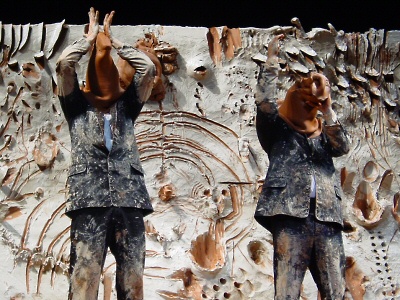
The Barbican’s cavernous auditorium is an imposing beast; a cathedral of expensive greys, acres of lavish shiny surfaces disappearing upwards towards the distant gods. Someone’s hopeful (but misguided) idea of a theatre for the future. All of which makes a wonderful contrast to the simple set (if it can be called a set) that adorns the empty stage at the beginning of Paso Doble, part of this year’s London International Mime Festival. Sat squat and solid in the middle of the stage are two giant flat chunks of wet clay, one horizontal and one vertical, earthy and hand made and glistening in the lights. Over the next hour they will be used by Miquel Barcelo and Josef Nadj (a Paris based artist and dancer respectively) to create an epic absurd monster of a production; a show that is at once art, performance, theatre and, almost, myth, smudging those narrow definitions in a visceral, visual feast of flying clay.
At the beginning however the clay is static and pure. Perfect - a fresh jar of peanut butter or satisfyingly thick layer of snow. It is an alien landscape, barren and desolate. That is until it begins to move, the unseen performers thumping the back of the upright wall of clay to force thick bubbles into its surface. Suddenly it becomes strangely alive, imbued with a fleshly malleability. It is squelchy, soft and thick – undeniably sensual. You can hear it slurping, you can feel its texture and its weight as it bends in the performers’ hands. As this primordial skin continues to blister and burst, hands can be seen appearing of it stretching open gaps in the clay. The audience giggles with delight.
When the two performers finally appear it is not, as might be predicted by bursting through this wall of clay but calmly walking out from behind it, dressed in pristine black suits and carrying huge sinister looking tools. Striking a pose and staring out at the audience they look like a bizarre version Grant Wood’s American Gothic, po-faced homesteaders ready to set to work on this barren landscape.
When they do begin to carve the clay however it is with a startling ferocity that absolutely took me by surprise. Thumping, slapping, pummelling, flaying – thick chunks of fleshy clay ripped away by huge metal tipped instruments, a spray of wet clay glinting in the light like blood spatter every time another blow is landed. At first the audience is giggling along but after a while the savagery becomes almost unbearable. Delivered with an exhausting impassiveness it reminded me at once of Jackson Pollock’s expressionistic assault on his canvas, Mel Gibson’s pornographically masochistic torture scenes in The Passion of the Christ and of the relentless toil of hacking away at the earth during a long summer spent farming in the muddy Fens. During this slow but relentless savagery the show becomes a mesmerising ritual, a telescoping of the creation of art, earth and man into a single dance of exhausting violence.
The interludes of silence during this attack, when the artists disappear behind the wall of clay, feel like much needed relief, both from their breathless work and Alain Mahe’s discordant musical accompaniment. As the lights dim slightly the audience is left gazing in dazzled wonder at the brutalized clay, scarred and beautiful.
If this all makes the show sound horribly earnest it absolutely isn’t. Both performers certainly have their tongues firmly stuck in their respective cheeks and their deadly serious personas come across like delightfully absurd Cohen brothers caricatures. This comic seriousness becomes more pronounced as the show goes on, the performers straight-facedly squashing a series of soft clay pots over their own heads and moulding them into ridiculous masks, resembling pigs and bulls and variety of appropriately mythic looking monsters. All the while the artists are increasingly becoming engulfed by their creation. The white and red clay splattering across their dark suits.
Slowly this repetitious comedy act builds into something far more disturbing. One of the performers becomes suffocatingly engulfed by the masks, with pot after pot squelching over his head and his arms and finally (magnificently) he is sprayed with wet clay until entirely engulfed by his creation. In a single haunting image he collapses into the fleshy wall behind him, all the while the spray of clay raining down over the scene to an almost deafening soundtrack. Ashes to ashes. Dust to dust. It is a beautiful, viscerally physical vignette – god absorbed by man, man engulfed by nature, the artist subsumed by his creation. A fitting climax to a magically unreal show.
For me this is what the Mime festival is all about. A confrontation with something startling and barely explicable (I have undoubtedly failed here). An absurd and hugely enjoyable spectacle that does not announce its meaning like a political address, but haunts you with a series of mesmerising movements and images and ideas. It is at once universal and abstract and yet ephemeral and immediate – in the smell of the clay, the whirling physicality of bodies in motion and the random shapes and images that they fleetingly create. Rarely have I seen a show that can bring such a sense of epic near-mythical spectacle and make it feel so very viscerally in the room with you.
This is a wonderful show – a ritualistic visual feast that only left me yearning that we couldn’t all skip over the Barbican’s plush seats and throw ourselves into this sublimely ridiculous act of creation.
Jan 13, 2008
The Tedious Hour
For a truly disturbing experience this weekend you needn't look any further than AA Gill's interview with David Hare in the Sunday Times today.
Apparently David Hare asked for AA Gill specifically - 'I'm only doing one piece of publicity for the play, so I thought it might as well be The Sunday Times, and it should be you.' In a staggeringly unconvincing display of the modesty he is famed for failing to possess, AA Gill claims to assume this is because Hare will consider him a 'soft touch'. It seems more likely however that both believe Hare was demanding a journalist of the imagined standard that he believed he deserved, as he begins with mundane and predictable side-swipe at The Critics, his main criticism being that they don't talk enough about David Hare any more - AA Gill to the rescue.
As part of his ongoing crusade to prove that AA Gill is better than all of theatre, AA Gill has taken this opportunity to attempt to best David Hare, an icon of what Gill sees as the theatre establishment and a man almost as pompous as he is. And so Gill ends every quotation from Hare with a snide rejoinder and finishes with a sneering affirmation of the fact that (like much of Hare's drama) when you are the one doing the writing, you can always come out looking cleverest. AA Gill must have poured himself a large glass of expensive but difficult wine and given himself a firm pat on the back when he finally emailed this of to the editor - another job well done, another mountain conquered.
In reality though, the whole thing comes across far more like too bald men fighting over an aphorism - and despite his belief in the importance of entertaining, the funniest and most insightful things Gill can muster are quotes from Stephen Fry and Michael Gambon, gentlemen who you can be sure would never feel the need to indulge in such an embarassing display of smug dick measuring.
The whole sad affair feels rather like rubber necking a car accident with egos. You end up swinging to and fro as to what's worse - Hare's tired theatrical binaries ("There are two sorts of playwright: those that use events and the real world, and those that just write out of their head" - so where do Kane/Crimp/Barker fit into this facile dichotomy?) and Gill's equally brainless put downs ("Theatre director is a new profession and, with a few exceptions, the ones we've got at the moment are pretty desperate."). Apparently the two are friends - the long nights of cigars on the veranda must absolutely fly by...
So where to next for the self-designated saviour of British Theatre. Perhaps AA Gill to direct a West End Revival of George Bernard Shaw? AA Gill to chair a live primetime debate on the future of theatre on BBC4?
I've heard it rumored that Arts Council England might need a spot of restructuring - anyone have a number for the Sunday Times?
Apparently David Hare asked for AA Gill specifically - 'I'm only doing one piece of publicity for the play, so I thought it might as well be The Sunday Times, and it should be you.' In a staggeringly unconvincing display of the modesty he is famed for failing to possess, AA Gill claims to assume this is because Hare will consider him a 'soft touch'. It seems more likely however that both believe Hare was demanding a journalist of the imagined standard that he believed he deserved, as he begins with mundane and predictable side-swipe at The Critics, his main criticism being that they don't talk enough about David Hare any more - AA Gill to the rescue.
As part of his ongoing crusade to prove that AA Gill is better than all of theatre, AA Gill has taken this opportunity to attempt to best David Hare, an icon of what Gill sees as the theatre establishment and a man almost as pompous as he is. And so Gill ends every quotation from Hare with a snide rejoinder and finishes with a sneering affirmation of the fact that (like much of Hare's drama) when you are the one doing the writing, you can always come out looking cleverest. AA Gill must have poured himself a large glass of expensive but difficult wine and given himself a firm pat on the back when he finally emailed this of to the editor - another job well done, another mountain conquered.
In reality though, the whole thing comes across far more like too bald men fighting over an aphorism - and despite his belief in the importance of entertaining, the funniest and most insightful things Gill can muster are quotes from Stephen Fry and Michael Gambon, gentlemen who you can be sure would never feel the need to indulge in such an embarassing display of smug dick measuring.
The whole sad affair feels rather like rubber necking a car accident with egos. You end up swinging to and fro as to what's worse - Hare's tired theatrical binaries ("There are two sorts of playwright: those that use events and the real world, and those that just write out of their head" - so where do Kane/Crimp/Barker fit into this facile dichotomy?) and Gill's equally brainless put downs ("Theatre director is a new profession and, with a few exceptions, the ones we've got at the moment are pretty desperate."). Apparently the two are friends - the long nights of cigars on the veranda must absolutely fly by...
So where to next for the self-designated saviour of British Theatre. Perhaps AA Gill to direct a West End Revival of George Bernard Shaw? AA Gill to chair a live primetime debate on the future of theatre on BBC4?
I've heard it rumored that Arts Council England might need a spot of restructuring - anyone have a number for the Sunday Times?
Jan 10, 2008
My Inevitable Two Cents on the Arts Council Hootenanny
Well.
Arts Council England.
Where do we start?
It’s not been a good week. Following several bouts of preparatory sparring, the theatre community yesterday were able to give executive director Peter Hewitt the bloodthirsty pummelling that they so wanted to – huing and crying and soapboxing and sound biting and generally performing a faintly repulsive and entirely unhelpful pantomime of aphoristic declamations, neatly rounded off by a headline grabbing and debate-suffocating ‘vote of no confidence’. Well done, well done all of you.
The problem for me is that arts community is now ostensibly holding a knife to its own nose and threatening to cut it off. Everything, everything, should be done to salvage the Arts Council. The alternatives are frankly terrifying – money handed out directly by a government who, in a couple of years time, are likely to be run by a man who has already demonstrated his contemptuous and smugly populist attitude towards theatre and the arts. A party and an ideology that fundamentally questions why theatre that is not able to make a profit should receive government funding to allow ‘artists’ to ponce around enjoying themselves.
Without the Arts Council what’s going to happen when funding quickly begins to be cut funding altogether, or to be channelled into what Mr Cameron terms ‘right[or should that be Right] causes’? Are we going to wheel out Sir Ian McKellan and Kevin Spacey again, to complain about our livelihoods being taken away? Will they be greeted with anything more than the disinterestedly amused tone of Mark Brown’s article (in The Guardian, for Christ’s sake, heaven forbid what the Daily Mail or The Telegraph would say)?
The Arts Council must be saved. This for me is a first principal – good theatre in this country (of any stripe) will not survive without it. Which is why I look at events like yesterday’s, and comments like Christine Payne’s (suggesting the ACE are "fundamentally and possibly irreparably damaged") as being almost as damaging to theatre as anything the arts council is doing. It’s all well and good rich Actors and Artistic Directors making melodramatic votes of no confidence in the ACE – it’s not their careers that are staked on its survival.
What we need is to begin to lobby for practical steps that can be taken to help revive an Arts Council who desperately need it. A new Chairman is about to be installed. Let’s prepare a series of positive changes to suggest to him (that may include reference to specific cuts) rather than machine gunning his predecessor – a man, who, frankly, is in no position to make concessions about the future of the ACE when he’s clearing his desk out in a couple of weeks time.
At Devoted and Disgruntled the two things that came up repeatedly from both those who were being supported by the arts council and those who were being cut, was more transparency and the inclusion of more peer review. Boom. There you go. That’s a start (one that the ever valiant Lyn Gardner has continues to trumpet on the Guardian Blog repeatedly, seeming ever more like an increasingly desperate Cassandra, watching the predicted disaster unfold in front of her).
There are two many agendas swilling around at the moment. People are too freely using ACE’s obvious failings as a stick with which to beat them for the decisions they have come to. People are all too quick to fly from these specific failings into a wholesale battle for the soul of theatre. I don’t support the idea of an arts council because I think it is likely to promote the kind of theatre I want, I don’t criticise it because it isn’t; I do both because with an Arts Council I simply won’t have the opportunity to make work, period. Or at least, it’ll be an awful lot harder. In this unreasoned maelstrom the claims of those with perfectly valid reasons to complain are diluted and misappropriated.
Look at the Bush for example. The Bush has my unqualified support in its attempts to reinstate its funding. It is an institution that continues to discover and support wonderful, talented theatre makers. It is unashamedly a small theatre and all the better for it. For a theatre to have so much influence and so much scope and such a legacy when it has less than 90 seats is a cause for celebration not for punishment. It is exactly the kind of place that can’t sustain itself on turnover and deserves the ACE’s support. That is all there is to it. Now how about we stop using this to draw a spurious line in the sand between modes of practise that, like some petty-minded War of the Roses, asks us to pick between two arbitrary constructs that relate nothing to the actual production of work.
Who’s voices are missing in all of this? Most of the time it’s the young companies. Those companies that don’t have a voice yet but in a few years (with the support of the Arts Council) might be doing some of the most exciting, wonderful, relevant things in theatre. For now, they remain obscured. They are the flipside to these cuts. They are the reason for these cuts. And though I don’t begrudge anyone failing to go gently into that sweet night, it’s important to remember that they must be given an opportunity to blossom, and that that opportunity will come at someone else’s expense. It’s tough. Brutal, in fact. And almost anyone making theatre must feel that their work is vital and significant and deserving of the ACE’s support, but there will never be enough to go round. While the water continues to be muddied between what the arts council has done and how they’ve done it, it is these young companies that will essentially suffer.
Or rather, it is everyone who will eventually suffer, for not cherishing a flawed, vital concept enough. For reaching for the knife when everybody else was, for joining a confused legion of conflicting agendas and collectively delivering ACE a vindictive death blow. If we don’t watch out, in the sweltering heat of this year’s messy protestations, we’ll do more harm than any ACE Chief Executive ever did.
[For the record, although I have worked for a variety of institutions that have been well-supported by ACE, in my capacity as a theatre maker I have had work directly funded by them]
Arts Council England.
Where do we start?
It’s not been a good week. Following several bouts of preparatory sparring, the theatre community yesterday were able to give executive director Peter Hewitt the bloodthirsty pummelling that they so wanted to – huing and crying and soapboxing and sound biting and generally performing a faintly repulsive and entirely unhelpful pantomime of aphoristic declamations, neatly rounded off by a headline grabbing and debate-suffocating ‘vote of no confidence’. Well done, well done all of you.
The problem for me is that arts community is now ostensibly holding a knife to its own nose and threatening to cut it off. Everything, everything, should be done to salvage the Arts Council. The alternatives are frankly terrifying – money handed out directly by a government who, in a couple of years time, are likely to be run by a man who has already demonstrated his contemptuous and smugly populist attitude towards theatre and the arts. A party and an ideology that fundamentally questions why theatre that is not able to make a profit should receive government funding to allow ‘artists’ to ponce around enjoying themselves.
Without the Arts Council what’s going to happen when funding quickly begins to be cut funding altogether, or to be channelled into what Mr Cameron terms ‘right[or should that be Right] causes’? Are we going to wheel out Sir Ian McKellan and Kevin Spacey again, to complain about our livelihoods being taken away? Will they be greeted with anything more than the disinterestedly amused tone of Mark Brown’s article (in The Guardian, for Christ’s sake, heaven forbid what the Daily Mail or The Telegraph would say)?
The Arts Council must be saved. This for me is a first principal – good theatre in this country (of any stripe) will not survive without it. Which is why I look at events like yesterday’s, and comments like Christine Payne’s (suggesting the ACE are "fundamentally and possibly irreparably damaged") as being almost as damaging to theatre as anything the arts council is doing. It’s all well and good rich Actors and Artistic Directors making melodramatic votes of no confidence in the ACE – it’s not their careers that are staked on its survival.
What we need is to begin to lobby for practical steps that can be taken to help revive an Arts Council who desperately need it. A new Chairman is about to be installed. Let’s prepare a series of positive changes to suggest to him (that may include reference to specific cuts) rather than machine gunning his predecessor – a man, who, frankly, is in no position to make concessions about the future of the ACE when he’s clearing his desk out in a couple of weeks time.
At Devoted and Disgruntled the two things that came up repeatedly from both those who were being supported by the arts council and those who were being cut, was more transparency and the inclusion of more peer review. Boom. There you go. That’s a start (one that the ever valiant Lyn Gardner has continues to trumpet on the Guardian Blog repeatedly, seeming ever more like an increasingly desperate Cassandra, watching the predicted disaster unfold in front of her).
There are two many agendas swilling around at the moment. People are too freely using ACE’s obvious failings as a stick with which to beat them for the decisions they have come to. People are all too quick to fly from these specific failings into a wholesale battle for the soul of theatre. I don’t support the idea of an arts council because I think it is likely to promote the kind of theatre I want, I don’t criticise it because it isn’t; I do both because with an Arts Council I simply won’t have the opportunity to make work, period. Or at least, it’ll be an awful lot harder. In this unreasoned maelstrom the claims of those with perfectly valid reasons to complain are diluted and misappropriated.
Look at the Bush for example. The Bush has my unqualified support in its attempts to reinstate its funding. It is an institution that continues to discover and support wonderful, talented theatre makers. It is unashamedly a small theatre and all the better for it. For a theatre to have so much influence and so much scope and such a legacy when it has less than 90 seats is a cause for celebration not for punishment. It is exactly the kind of place that can’t sustain itself on turnover and deserves the ACE’s support. That is all there is to it. Now how about we stop using this to draw a spurious line in the sand between modes of practise that, like some petty-minded War of the Roses, asks us to pick between two arbitrary constructs that relate nothing to the actual production of work.
Who’s voices are missing in all of this? Most of the time it’s the young companies. Those companies that don’t have a voice yet but in a few years (with the support of the Arts Council) might be doing some of the most exciting, wonderful, relevant things in theatre. For now, they remain obscured. They are the flipside to these cuts. They are the reason for these cuts. And though I don’t begrudge anyone failing to go gently into that sweet night, it’s important to remember that they must be given an opportunity to blossom, and that that opportunity will come at someone else’s expense. It’s tough. Brutal, in fact. And almost anyone making theatre must feel that their work is vital and significant and deserving of the ACE’s support, but there will never be enough to go round. While the water continues to be muddied between what the arts council has done and how they’ve done it, it is these young companies that will essentially suffer.
Or rather, it is everyone who will eventually suffer, for not cherishing a flawed, vital concept enough. For reaching for the knife when everybody else was, for joining a confused legion of conflicting agendas and collectively delivering ACE a vindictive death blow. If we don’t watch out, in the sweltering heat of this year’s messy protestations, we’ll do more harm than any ACE Chief Executive ever did.
[For the record, although I have worked for a variety of institutions that have been well-supported by ACE, in my capacity as a theatre maker I have had work directly funded by them]
Jan 7, 2008
Glasses (Half-Full/Half-Empty)
Well, the year is nary a week old and already I've been accused of harbouring a world weary cynicism (he says, while sinking back into a rich upholstered chair and taking pointed drags on a decaying Gauloises). So attempting to recapture the twinkling hopefulness of my ailing youth, I've written a relentlessly upbeat article for the Guardian, praising the Brave New World of the internet.
Through this burgeoning little network of writers and theatre makers, people can start to find the shows, the companies and the performers they might otherwise have missed; secrets that might have remained the domain of those shadowy people referred to as "in the know". People can be connected with those tiny, wonderful experiences that make theatre a place of magical possibilities.I also recommend a few things that I'm looking forward to in the next month or so, from Rotozoza to the mighty Chris Goode (he of the most sparkling music reviews you can possibly imagine). But now, dear reader, I'm calling on you to prove me right - what can you recommend that I should see in the coming months? I'm handing my (purely metaphorical as I'm utterly incapable of maintaining one) diary to you and asking you to scribble all over it. So please, do your worst.
Dec 29, 2007
Future Perfect.
As 2007 lies waxily on its death bed, coughing quietly and trying not to make a fuss, I thought it might be interesting to look to the year ahead - what excitements might it hold? What glorious adventures await? Who will I end up needlessly and foolishly offending in 2008? Let's gaze into the tea leaves briefly, shall we...
January
The London International Mime Festival opens. No one notices.
February
Following news that the Old Vic’s star studded Speed-the-Plow is not selling well enough, Kevin Spacey jumps to rescue in the only way he knows how. A poorly proofed Old Vic press release lands on in our inboxes proudly announcing that Hollywood sweetheart Denise Richards has become Assistant Stage Manager on the production, while the role of Audience Member Who Has Left His Mobile Phone On will be played by Jonny Lee Miller, with Dakota Fanning putting in a cameo has his embarrassed daughter. No news yet on who will be taking the part of Artistic Director.
March
Jersey Boys opens. The Bergerac Fan Club leave at the interval, crushingly disappointed.
April
Struggling for anything else to write, the critics decide to begin a new debate about theatre blogging by suggesting that in an environment where ‘everyone’s a critic’ our theatre culture loses its rigour. Meanwhile in an attempt to devote more space to adverts, newspaper critics are asked if it would be possible to reduce the length of their reviews slightly, replacing the tradition 300 words with a simple ‘Yes’ or ‘No’.
May
Still with nothing to write about, the critics are getting desperate – regularly calling Nick Hytner begging him to say something incendiary. Finally Martin Crimp’s The City opens at the Royal Court, directed by Katie Mitchell. Critics dine out on condescension for the rest of the month.
June
Black Watch finally lands in London, to a collective critical orgasm from the first stringers. Billington, Spencer and De Jongh trip over each other to claim that the production demonstrates the perfect alliance between formal experiment and the political content, conclusively (I said conclusively) proving that the Future of Theatre™ is much the same as the Present of Theatre, with a bit more dancing.
July
Nothing happens in July. Literally nothing.
August
The Edinburgh Fringe Festival arrives to a maelstrom of complaints on the Guardian website from irritated people in London bored of hearing people talk about the Edinburgh Fringe Festival. These whingers are quickly repelled by a second wave of commenters highlighting how obsessed people are with London the rest of the year. However, in a haunting echo of the Spanish Civil War, this second group quickly becomes riven by infighting over the issue of whether Edinburgh gives more attention to theatre in the regions or is a distraction from it. Following an article by Lyn Gardner claiming that this was a return to form for the festival the debate grows so large that, unable to retain coherency or structure, it collapses, leaking irately polite comments across the Guardian Website.
September
Slung Low’s Helium, winner of the Samuel Beckett Trust Award 2008, opens at the Barbican. Despite being a wonderful production, the makers quickly realise that the awfulness of previous winners has opened up a critical vacuum in the Pit Theatre, sucking in positive adjectives and review stars, rendering the show tragically luke warm.
October
Michael Grandage announces his new season at the Donmar, which will include a half week long run for a production of A View from the Bridge, starring Prince William and the body of John Gielgud. Tickets sell out so fast they actually rupture time, throwing some ticket buyers back in time several years to the moment at which the Donmar last did something interesting.
November
Guardian critic Michael Billington becomes so obsessed by his dislike of sensory titillation he makes the surprising demand that he hears, smells and sees nothing at the theatre. If only, he asserts, there was some way of imbibing political drama as a purely abstract concept, without the lights and the sounds and the theatre to distract us from the serious business of theatre.
December
Michael Billington is bought a book for Christmas. He retires happy.
Have a Happy New Year.*
(Thought let's get a few things straight about New Year. It's a horrible celebration. As a consequence of the fact that everyone is required to celebrate at precisely the same time, it has somehow become this grotesque fun-off, in which bands of anxious revellers are pitted against each other in some kind of joy-sucking battle to identify the coolest people. Why is it that this party, more than any other is required to represent us - who our friends are, what we like doing, how much fun we are capable of having. I simply can't have fun under all this pressure. Anyway, enough of that or Woody Allen will be round demanding royalties.)
January
The London International Mime Festival opens. No one notices.
February
Following news that the Old Vic’s star studded Speed-the-Plow is not selling well enough, Kevin Spacey jumps to rescue in the only way he knows how. A poorly proofed Old Vic press release lands on in our inboxes proudly announcing that Hollywood sweetheart Denise Richards has become Assistant Stage Manager on the production, while the role of Audience Member Who Has Left His Mobile Phone On will be played by Jonny Lee Miller, with Dakota Fanning putting in a cameo has his embarrassed daughter. No news yet on who will be taking the part of Artistic Director.
March
Jersey Boys opens. The Bergerac Fan Club leave at the interval, crushingly disappointed.
April
Struggling for anything else to write, the critics decide to begin a new debate about theatre blogging by suggesting that in an environment where ‘everyone’s a critic’ our theatre culture loses its rigour. Meanwhile in an attempt to devote more space to adverts, newspaper critics are asked if it would be possible to reduce the length of their reviews slightly, replacing the tradition 300 words with a simple ‘Yes’ or ‘No’.
May
Still with nothing to write about, the critics are getting desperate – regularly calling Nick Hytner begging him to say something incendiary. Finally Martin Crimp’s The City opens at the Royal Court, directed by Katie Mitchell. Critics dine out on condescension for the rest of the month.
June
Black Watch finally lands in London, to a collective critical orgasm from the first stringers. Billington, Spencer and De Jongh trip over each other to claim that the production demonstrates the perfect alliance between formal experiment and the political content, conclusively (I said conclusively) proving that the Future of Theatre™ is much the same as the Present of Theatre, with a bit more dancing.
July
Nothing happens in July. Literally nothing.
August
The Edinburgh Fringe Festival arrives to a maelstrom of complaints on the Guardian website from irritated people in London bored of hearing people talk about the Edinburgh Fringe Festival. These whingers are quickly repelled by a second wave of commenters highlighting how obsessed people are with London the rest of the year. However, in a haunting echo of the Spanish Civil War, this second group quickly becomes riven by infighting over the issue of whether Edinburgh gives more attention to theatre in the regions or is a distraction from it. Following an article by Lyn Gardner claiming that this was a return to form for the festival the debate grows so large that, unable to retain coherency or structure, it collapses, leaking irately polite comments across the Guardian Website.
September
Slung Low’s Helium, winner of the Samuel Beckett Trust Award 2008, opens at the Barbican. Despite being a wonderful production, the makers quickly realise that the awfulness of previous winners has opened up a critical vacuum in the Pit Theatre, sucking in positive adjectives and review stars, rendering the show tragically luke warm.
October
Michael Grandage announces his new season at the Donmar, which will include a half week long run for a production of A View from the Bridge, starring Prince William and the body of John Gielgud. Tickets sell out so fast they actually rupture time, throwing some ticket buyers back in time several years to the moment at which the Donmar last did something interesting.
November
Guardian critic Michael Billington becomes so obsessed by his dislike of sensory titillation he makes the surprising demand that he hears, smells and sees nothing at the theatre. If only, he asserts, there was some way of imbibing political drama as a purely abstract concept, without the lights and the sounds and the theatre to distract us from the serious business of theatre.
December
Michael Billington is bought a book for Christmas. He retires happy.
Have a Happy New Year.*
(Thought let's get a few things straight about New Year. It's a horrible celebration. As a consequence of the fact that everyone is required to celebrate at precisely the same time, it has somehow become this grotesque fun-off, in which bands of anxious revellers are pitted against each other in some kind of joy-sucking battle to identify the coolest people. Why is it that this party, more than any other is required to represent us - who our friends are, what we like doing, how much fun we are capable of having. I simply can't have fun under all this pressure. Anyway, enough of that or Woody Allen will be round demanding royalties.)
Subscribe to:
Posts (Atom)


