For CultureWars.org.uk
Dead Wedding, the latest show by the staggeringly brilliant puppeteers Faulty Optic, is a startlingly uncomfortable experience. Draining, desolate and riddled with off-kilter melancholy, this is a brooding, lyrically bleak hour and a half of netherworldy puppetry.
Dead wedding takes as its starting point the myth of Orpheus and Eurydice, a story that seems to returning with a troubling regularity; as if there is something about it, the doomed attempts at overcoming death, the inevitability of human weakness, that nags at us. In Faulty Optic’s retelling the story has an almost political resonance to it, the feel of a show created while war reports blare from the television in the background. Indeed, we begin like something out of a piece of scathing anti-Neo Con agitprop, with bloated half naked Pluto, god of the underworld, sat squatly over a grave stone that he is ringing like a slot machine, sending coins fountaining up around him to his obvious glee.
From the start the myth, as far as we know it, has run its course. We are already in the underworld. A post-apocalyptic scrapheap Hades of rusting tin drums and salvaged bric-a-brac. Eurydice washes her memory away repetitively in a crude industrial shower and an amputee Orpheus, like a ghoulish down-and-out Vietnam veteran, scuttles around on a tiny wooden cart, unable to find the legs ripped away by the frenzied Bacchae. This Hades is a desolate, listless place, bathed in palid green light and echoing to a soundscape half-heard sentences drowned in dissonant blending of electronica and live string music.
In this post-traumatic universe Orpheus struggles to grasp the normality of his previous life, setting up Kodak moment dates with the distracted Eurydice that feel distorted, dangerous and hollow. Playing his lyre (and with two crude puppet masks made from Jiffy bags) he tries to recapture normality, his tiny erratic gestures bristling with a fierce, doomed hopefulness.
There is a haunting absence of humanity in this disturbing little world, even the faces of the puppeteers are concealed behind sinister black vales. The smooth, near-perfecct manipulation of the puppets is a striking contrast to the halting, juddery movement of their creations – crawling in stylised bursts across their tattered landscape.
This unworldly movement is brilliantly effective when it serves the company’s most punchy and disturbing scenes, crudely metaphorical vignettes that touch the dark absurdity of Terry Gilliam. Possibly the best of the of them all is a beautiful scene in which the dainty figures of Orpheus and Eurydice dance jaggedly on the top of great white wedding cake, slowly however a giant sinister creature (like a winged Cerberus) hovers into the scene pecking Eurydice to pieces in front of the tiny devastated figure of Orpheus. While he still grasps at her headless torso Pluto blusters in, threatening Orpheus with a long knife before brutally slicing the cake in two, amputating the lovers from each other, and scoffing from its centre. Almost Punch and Judyish in its absurd cruelty, the scene is beautiful, macabre and effortlessly haunting.
At times though the relentless inhumanity of this scarred universe does become almost unbearable. Mira Calix mesmerising and deafening loud musical score writhes under your skin with a prikly jerkiness that perfectly matches the small figures cavorting across the stage. By the end of ninety minutes there is little surprise, indeed only a crushing inevitability, in the bleakness of the show’s ending, as Orpheus abandons his futile attempts to reclaim love, the past and normality, instead cutting the strings of his Lyre and drowning himself in his own forgetting; a cruel reflection of our own listless response to a world mired in tragedy.
Showing posts with label London International Mime Festival. Show all posts
Showing posts with label London International Mime Festival. Show all posts

Jan 17, 2008
Paso Doble at the Barbican
Review for CultureWars.org.uk
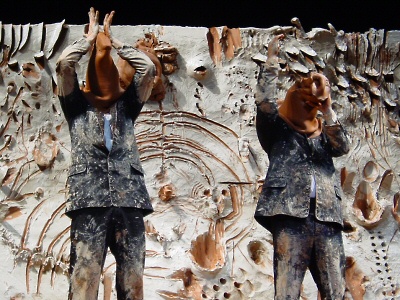
The Barbican’s cavernous auditorium is an imposing beast; a cathedral of expensive greys, acres of lavish shiny surfaces disappearing upwards towards the distant gods. Someone’s hopeful (but misguided) idea of a theatre for the future. All of which makes a wonderful contrast to the simple set (if it can be called a set) that adorns the empty stage at the beginning of Paso Doble, part of this year’s London International Mime Festival. Sat squat and solid in the middle of the stage are two giant flat chunks of wet clay, one horizontal and one vertical, earthy and hand made and glistening in the lights. Over the next hour they will be used by Miquel Barcelo and Josef Nadj (a Paris based artist and dancer respectively) to create an epic absurd monster of a production; a show that is at once art, performance, theatre and, almost, myth, smudging those narrow definitions in a visceral, visual feast of flying clay.
At the beginning however the clay is static and pure. Perfect - a fresh jar of peanut butter or satisfyingly thick layer of snow. It is an alien landscape, barren and desolate. That is until it begins to move, the unseen performers thumping the back of the upright wall of clay to force thick bubbles into its surface. Suddenly it becomes strangely alive, imbued with a fleshly malleability. It is squelchy, soft and thick – undeniably sensual. You can hear it slurping, you can feel its texture and its weight as it bends in the performers’ hands. As this primordial skin continues to blister and burst, hands can be seen appearing of it stretching open gaps in the clay. The audience giggles with delight.
When the two performers finally appear it is not, as might be predicted by bursting through this wall of clay but calmly walking out from behind it, dressed in pristine black suits and carrying huge sinister looking tools. Striking a pose and staring out at the audience they look like a bizarre version Grant Wood’s American Gothic, po-faced homesteaders ready to set to work on this barren landscape.
When they do begin to carve the clay however it is with a startling ferocity that absolutely took me by surprise. Thumping, slapping, pummelling, flaying – thick chunks of fleshy clay ripped away by huge metal tipped instruments, a spray of wet clay glinting in the light like blood spatter every time another blow is landed. At first the audience is giggling along but after a while the savagery becomes almost unbearable. Delivered with an exhausting impassiveness it reminded me at once of Jackson Pollock’s expressionistic assault on his canvas, Mel Gibson’s pornographically masochistic torture scenes in The Passion of the Christ and of the relentless toil of hacking away at the earth during a long summer spent farming in the muddy Fens. During this slow but relentless savagery the show becomes a mesmerising ritual, a telescoping of the creation of art, earth and man into a single dance of exhausting violence.
The interludes of silence during this attack, when the artists disappear behind the wall of clay, feel like much needed relief, both from their breathless work and Alain Mahe’s discordant musical accompaniment. As the lights dim slightly the audience is left gazing in dazzled wonder at the brutalized clay, scarred and beautiful.
If this all makes the show sound horribly earnest it absolutely isn’t. Both performers certainly have their tongues firmly stuck in their respective cheeks and their deadly serious personas come across like delightfully absurd Cohen brothers caricatures. This comic seriousness becomes more pronounced as the show goes on, the performers straight-facedly squashing a series of soft clay pots over their own heads and moulding them into ridiculous masks, resembling pigs and bulls and variety of appropriately mythic looking monsters. All the while the artists are increasingly becoming engulfed by their creation. The white and red clay splattering across their dark suits.
Slowly this repetitious comedy act builds into something far more disturbing. One of the performers becomes suffocatingly engulfed by the masks, with pot after pot squelching over his head and his arms and finally (magnificently) he is sprayed with wet clay until entirely engulfed by his creation. In a single haunting image he collapses into the fleshy wall behind him, all the while the spray of clay raining down over the scene to an almost deafening soundtrack. Ashes to ashes. Dust to dust. It is a beautiful, viscerally physical vignette – god absorbed by man, man engulfed by nature, the artist subsumed by his creation. A fitting climax to a magically unreal show.
For me this is what the Mime festival is all about. A confrontation with something startling and barely explicable (I have undoubtedly failed here). An absurd and hugely enjoyable spectacle that does not announce its meaning like a political address, but haunts you with a series of mesmerising movements and images and ideas. It is at once universal and abstract and yet ephemeral and immediate – in the smell of the clay, the whirling physicality of bodies in motion and the random shapes and images that they fleetingly create. Rarely have I seen a show that can bring such a sense of epic near-mythical spectacle and make it feel so very viscerally in the room with you.
This is a wonderful show – a ritualistic visual feast that only left me yearning that we couldn’t all skip over the Barbican’s plush seats and throw ourselves into this sublimely ridiculous act of creation.
The Barbican’s cavernous auditorium is an imposing beast; a cathedral of expensive greys, acres of lavish shiny surfaces disappearing upwards towards the distant gods. Someone’s hopeful (but misguided) idea of a theatre for the future. All of which makes a wonderful contrast to the simple set (if it can be called a set) that adorns the empty stage at the beginning of Paso Doble, part of this year’s London International Mime Festival. Sat squat and solid in the middle of the stage are two giant flat chunks of wet clay, one horizontal and one vertical, earthy and hand made and glistening in the lights. Over the next hour they will be used by Miquel Barcelo and Josef Nadj (a Paris based artist and dancer respectively) to create an epic absurd monster of a production; a show that is at once art, performance, theatre and, almost, myth, smudging those narrow definitions in a visceral, visual feast of flying clay.
At the beginning however the clay is static and pure. Perfect - a fresh jar of peanut butter or satisfyingly thick layer of snow. It is an alien landscape, barren and desolate. That is until it begins to move, the unseen performers thumping the back of the upright wall of clay to force thick bubbles into its surface. Suddenly it becomes strangely alive, imbued with a fleshly malleability. It is squelchy, soft and thick – undeniably sensual. You can hear it slurping, you can feel its texture and its weight as it bends in the performers’ hands. As this primordial skin continues to blister and burst, hands can be seen appearing of it stretching open gaps in the clay. The audience giggles with delight.
When the two performers finally appear it is not, as might be predicted by bursting through this wall of clay but calmly walking out from behind it, dressed in pristine black suits and carrying huge sinister looking tools. Striking a pose and staring out at the audience they look like a bizarre version Grant Wood’s American Gothic, po-faced homesteaders ready to set to work on this barren landscape.
When they do begin to carve the clay however it is with a startling ferocity that absolutely took me by surprise. Thumping, slapping, pummelling, flaying – thick chunks of fleshy clay ripped away by huge metal tipped instruments, a spray of wet clay glinting in the light like blood spatter every time another blow is landed. At first the audience is giggling along but after a while the savagery becomes almost unbearable. Delivered with an exhausting impassiveness it reminded me at once of Jackson Pollock’s expressionistic assault on his canvas, Mel Gibson’s pornographically masochistic torture scenes in The Passion of the Christ and of the relentless toil of hacking away at the earth during a long summer spent farming in the muddy Fens. During this slow but relentless savagery the show becomes a mesmerising ritual, a telescoping of the creation of art, earth and man into a single dance of exhausting violence.
The interludes of silence during this attack, when the artists disappear behind the wall of clay, feel like much needed relief, both from their breathless work and Alain Mahe’s discordant musical accompaniment. As the lights dim slightly the audience is left gazing in dazzled wonder at the brutalized clay, scarred and beautiful.
If this all makes the show sound horribly earnest it absolutely isn’t. Both performers certainly have their tongues firmly stuck in their respective cheeks and their deadly serious personas come across like delightfully absurd Cohen brothers caricatures. This comic seriousness becomes more pronounced as the show goes on, the performers straight-facedly squashing a series of soft clay pots over their own heads and moulding them into ridiculous masks, resembling pigs and bulls and variety of appropriately mythic looking monsters. All the while the artists are increasingly becoming engulfed by their creation. The white and red clay splattering across their dark suits.
Slowly this repetitious comedy act builds into something far more disturbing. One of the performers becomes suffocatingly engulfed by the masks, with pot after pot squelching over his head and his arms and finally (magnificently) he is sprayed with wet clay until entirely engulfed by his creation. In a single haunting image he collapses into the fleshy wall behind him, all the while the spray of clay raining down over the scene to an almost deafening soundtrack. Ashes to ashes. Dust to dust. It is a beautiful, viscerally physical vignette – god absorbed by man, man engulfed by nature, the artist subsumed by his creation. A fitting climax to a magically unreal show.
For me this is what the Mime festival is all about. A confrontation with something startling and barely explicable (I have undoubtedly failed here). An absurd and hugely enjoyable spectacle that does not announce its meaning like a political address, but haunts you with a series of mesmerising movements and images and ideas. It is at once universal and abstract and yet ephemeral and immediate – in the smell of the clay, the whirling physicality of bodies in motion and the random shapes and images that they fleetingly create. Rarely have I seen a show that can bring such a sense of epic near-mythical spectacle and make it feel so very viscerally in the room with you.
This is a wonderful show – a ritualistic visual feast that only left me yearning that we couldn’t all skip over the Barbican’s plush seats and throw ourselves into this sublimely ridiculous act of creation.
Subscribe to:
Posts (Atom)